


The Physics of Perfect Pour-Over Coffee
- Science
- April 28, 2025
- No Comment
- 84
More than a billion cups of coffee are consumed daily: French-press, espresso, cold brew, whatever it takes.
Arnold Mathijssen, a physicist at the University of Pennsylvania, is partial to pour-over coffee, which involves manually pouring hot water over ground beans and filtering it into a pot or mug below. Surely, he figured, applying the principles of fluid dynamics to the process could make it even better.
With two students of similar mind, Dr. Mathijssen began studying how to optimize the pour in a pour over. Their science-backed advice: Pour high, slow and with a steady stream of water. This ensures the greatest extraction from minimal grounds, enhancing the coffee’s flavor without added beans or cost.
The findings, published this month in the journal Physics of Fluids, highlight how processes that unfold in the kitchen — from making foie gras to whipping up a plate of cacio e pepe — can inspire new scientific directions. In turn, science can enhance the art of cuisine.
“Kitchen science starts off with a relatively low entry barrier,” Dr. Mathijssen said. “But it’s more than just cute. Sometimes fundamental things can come out of it.”
Dr. Mathijssen primarily studies the physics of biological flows, such as the way bacteria swim upstream in blood vessels. But when he lost access to his lab during the Covid-19 shutdown, he started playing with his food — literally. He shook up bottles of whiskey, tested the stickiness of pasta and slid coins down slopes made of whipped cream and honey. The interest culminated in a 77-page review, structured like a menu, of the physics involved in making a meal.
“It got totally out of hand,” Dr. Mathijssen said. “You just realize science is everywhere.”
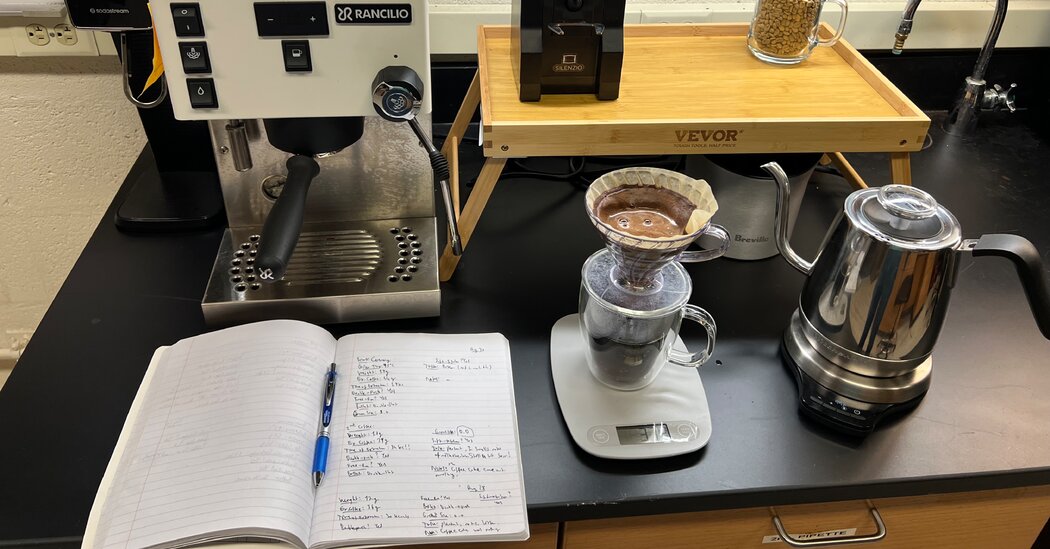
Dr. Mathijssen has since returned to the lab, but the passion for kitchen physics has stuck. The coffee study was partly inspired by a scientist in his group who kept detailed notes about pour-over brews prepared in the lab each day. The notes included information about where the beans had come from, the extraction time and the brew’s flavor profile.
Ernest Park, a graduate student in the lab, designed a formal experiment. Using silica gel beads in a glass cone, the scientists simulated the action of water being poured over coffee grounds from different heights, recording the dynamics of the system with a high-speed camera.
#Physics #Perfect #PourOver #Coffee