



Analysts See More Gains in Alibaba after Stellar 2025 Rally
- Economy
- September 29, 2025
- No Comment
- 47
Please note that we are not authorised to provide any investment advice. The content on this page is for information purposes only.
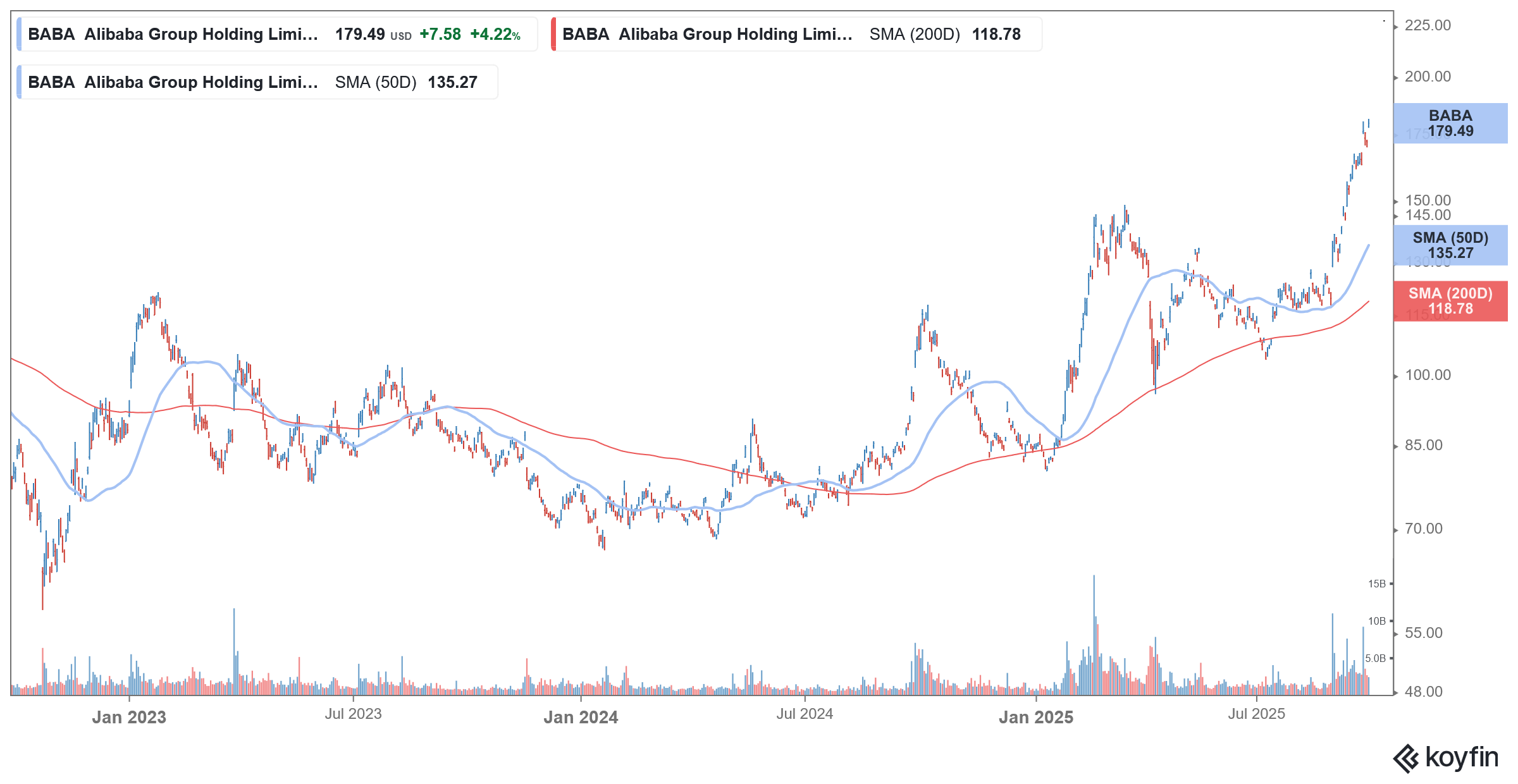
Alibaba stock has more than doubled this year, and analysts see more gains ahead for the Chinese tech giant as the sentiment towards Chinese stocks improves.
Morningstar raised its fair estimate for Alibaba by 49% to $267 on Friday. “We think higher capex is essential to meet the stronger-than-expected demand for AI infrastructure domestically and internationally,” said Morningstar analyst Chelsey Tam. She added, “The projected surge in global data center energy consumption signals a robust outlook for cloud revenue.”
Jefferies also raised Alibaba’s target price from $178 to $230 as brokerages seem impressed with the company’s AI pivot.
Alibaba Launched New AI Models Last Week
Last week, Alibaba launched a new artificial intelligence (AI) model and announced plans to hike its AI spending as it strives to solidify its position as a major player in the global AI landscape.
Alibaba’s CEO, Eddie Wu, announced that Alibaba plans to increase its spending on AI infrastructure and development, exceeding the previously announced three-year, 380-billion-yuan ($53 billion) initiative.
“The industry’s development speed far exceeded what we expected, and the industry’s demand for AI infrastructure also far exceeded our anticipation,” Wu told a developer conference in Hangzhou.
At that event, Alibaba also announced a deal with Nvidia where it would integrate the latter’s AI development tools for training for robotics and autonomous cars.
Morgan Stanley, which raised the target for Alibaba to $200, said it was “incrementally bullish on Alicloud’s outlook” following the Hangzhou conference.”
It added, “We raise our cloud growth estimates to 32% for F26 and 40% for F27, driven by increased capex, model upgrades, strategic partnerships, and accelerated international expansion.”
AI Is Fueling Demand for Alibaba Cloud
Alibaba Cloud, the company’s cloud computing arm, demonstrated strong momentum with revenues rising 26% year-over-year in the June quarter, an acceleration from the previous quarter. The company harped on the triple-digit year-over-year growth of its AI-related product revenue. This marks the eighth consecutive quarter of such growth, underscoring the strong market adoption of its AI solutions.
While there were previously concerns over tech companies’ ability to generate commensurate return on investment (ROI) on their AI investments, many, including Alibaba, have shown strong progress.
“Companies only gain confidence to invest more when the visibility of the returns improve,” said Vey-Sern Ling, managing director at Union Bancaire Privee. He added, “So when they say they are raising investments in AI it indicates good demand from customers and good ROI.”
In yet another validation of its AI strategy, earlier this month, Alibaba secured a major deal with state-owned telecom company China Unicom to supply AI chips for a new data center.
Of the nearly 23,000 domestically made AI chips currently powering the initial phase of the data center, Alibaba’s chip unit, T-Head, supplied approximately 72%. The remaining chips were sourced from other Chinese companies, including MetaX, Biren Tech, and Zhonghao Xinying, with plans to procure additional chips from Tecorigin (Wuxi), Moore Threads, and Enflame.
US-China Tech Standoff
This partnership is particularly noteworthy in the context of the ongoing US-China technology standoff. The United States has imposed strict export controls on advanced AI chips, primarily targeting products from industry leader Nvidia, to prevent them from being used for military and national security purposes in China. This has created a vacuum in the Chinese market and spurred domestic companies to accelerate their own chip development.
A key feature of Alibaba’s new chip is that a Chinese company is manufacturing it. This marks a significant departure from the past, where Alibaba’s earlier AI processors were fabricated by Taiwan Semiconductor Manufacturing Company (TSMC), a firm that the US has since restricted from producing cutting-edge AI chips for China. This shift to domestic manufacturing is in direct alignment with China’s broader national strategy to build a homegrown semiconductor ecosystem and lessen its dependence on foreign technology.
Alibaba Was the Face of China’s Tech Crackdown
Many US investors shunned Chinese tech stocks in 2021 after the country’s brutal tech crackdown. However, Chinese stocks are now back on the radar of global funds. Since last year, China has announced several monetary and fiscal measures to support its economy, which is suffering from structural issues ranging from slow growth in domestic consumption, an aging economy, a property market slump, and external risks emanating from tariffs on Chinese exports by several countries, including the US, which is its biggest trading partner.
The country has also changed its stance towards private companies, in particular tech giants, and far from a crackdown, it is backing them amid the tech war with the US. Earlier this year, Chinese President Xi Jinping met the country’s entrepreneurs, including Alibaba’s co-founder Jack Ma, at a symposium. Ma’s participation in the event with Jinping becomes all the more important as the Chinese billionaire was the face of China’s crackdown on its tech moguls, whom the Communist Party believed had become too big for their shoes.
At that meeting, Xi stressed, “Now is the perfect time for private enterprises and entrepreneurs to thrive.” He called upon Chinese companies and entrepreneurs to “show their talent” while adding, “The new era and new journey have broad prospects for the development of the private economy and great potential.”
Chinese Stocks Are Back on Global Funds’ Radar
Chinese shares are no longer “uninvestible” for global funds, and on the contrary, there seems to be a fear of missing out (FOMO) trade ever since DeepSeek announced its low-cost AI model.
Yerlan Syzdykov, global head of emerging markets at Amundi UK Ltd, echoes similar views and said, “Global investors will increase their allocations to Chinese assets in the coming years,” listing “FOMO” as among the drivers of that trade.
According to Joseph Zhang, a portfolio manager for Fidelity International, who has been increasing holdings in the Chinese market, “Global investors have been growing notably more interested in Chinese assets.”
He added, “This year is different in the sense that the revaluation of Chinese assets is no longer a policy-fueled frenzy but driven by better fundamentals. Investor confidence will likely grow stronger.”
#Analysts #Gains #Alibaba #Stellar #Rally