


The Warner Bros. Curse : Planet Money : NPR
- Politics
- December 16, 2025
- No Comment
- 9

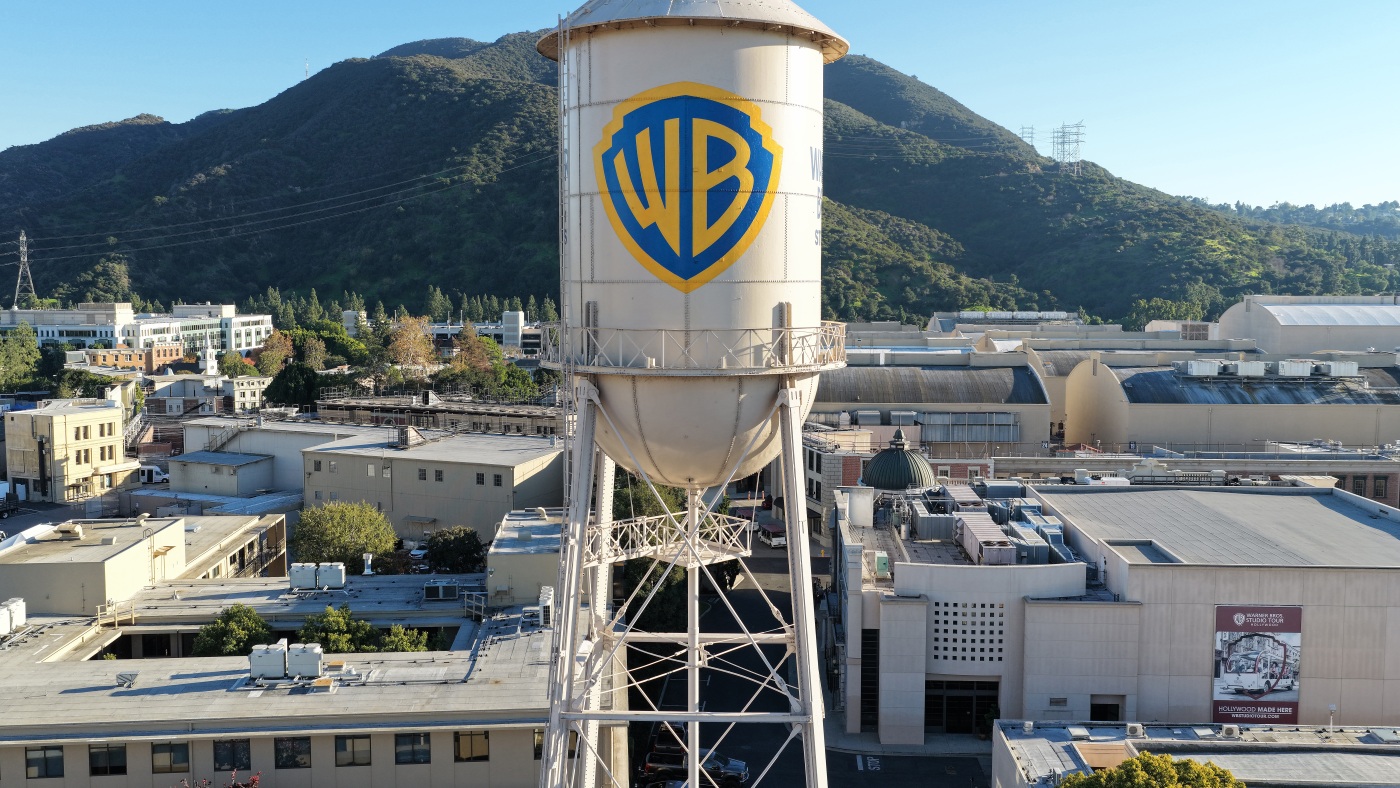
An aerial view of the Warner Bros. logo displayed on the water tower at Warner Bros. Studio on Dec. 5, 2025 in Burbank, Calif.
Mario Tama/Getty Images
hide caption
toggle caption
Mario Tama/Getty Images
Netflix and Paramount are in One Big Battle After Another to buy the storied Hollywood studio Warner Bros. (Yes, One Battle After Another is a Warner Bros. movie).
This isn’t the first time Warner Bros. has been at the center of headline-grabbing merger or acquisition. Actually, Warner Bros. has a long history of messy corporate marriages and divorces. It could be a cautionary tale about the dangers of mergers and acquisitions. You could even call it the Warner Bros. Curse.
Over the last decade alone, the Warner Bros. Curse has shown itself at least twice. In 2018, after a two-year regulatory battle, AT&T acquired what was then called Time Warner for $85.4 billion, and renamed the company WarnerMedia. Many believed AT&T overpaid for the company, and the stock market never seemed to really love this deal. WarnerMedia struggled to find big profits in streaming, its movie business was devastated by the pandemic, and the companies’ cultures never really jibed with each other.
And so — in a deal that represented tens of billions of dollars in losses for its shareholders — AT&T sold shares and ceded control of WarnerMedia to Discovery Inc. The two officially merged in 2022, forming Warner Bros. Discovery, which is still this Frankenstein of a company’s name (Frankenstein is another Warner Bros. property).
Since then, the company has made a series of bizarre decisions, like rebranding its streaming service HBO as HBO Max and then Max and then back to HBO Max. There were other debacles. Like, despite the movie being nearly done — and despite the fact they had spent nearly $90 million making it — Warner Bros. Discovery shelved BatGirl (and apparently wrote the loss off on their taxes). More recently, the company bought the rights to stream the show Mad Men, and as part of its release on the streaming platform, it sought to remaster the series into a widescreen, 4K format. But the production team apparently failed to do their due diligence and make sure it all looked good before releasing it. The result: those who watched Mad Men on HBO Max saw things like the production crew in the frame, including, in one scene, a technician holding a “vomit hose” as one of their actors pretended to throw up. This whole chapter of Warner Bros. history has proven to be, um, Looney Tunes.
Economists who study mergers and acquisitions have long puzzled over why so many corporate marriages go wrong. “Study after study puts the failure rate of mergers and acquisitions somewhere between 70% and 90%,” wrote the legendary Harvard Business School scholar Clayton Christensen and colleagues in Harvard Business Review back in 2011. The story of Warner Bros. is a pretty interesting case study to get an understanding of why so many mergers and acquisitions fail.
The most glaring example of the Warner Bros. Curse happened at the turn of the millennium. It’s widely considered to be one of the worst — if not the worst — mergers of all time. It was so bad that it’s still studied in business schools.
Today in the Planet Money newsletter, we look at that disastrous merger. And we ponder some reasons why so many mergers and acquisitions fail.
The merger of the century
In October 1999, Steve Case, the CEO of America Online (AOL), made a fateful phone call to Gerald Levin, the CEO of Time Warner.
At the time, Case was only 41 years old, but, over the previous 15 years, he had built one of the most exciting companies in America. Before AOL, the internet was largely a place for geeks and bureaucrats. Case’s company had made the internet accessible to tens of millions of normal Americans. In 1998, the company’s popularity even inspired a zeitgeisty rom-com, You’ve Got Mail (which, you guessed it, was produced and distributed by Warner Bros.) In the midst of dotcom mania in the late 1990s, AOL’s share price was rocketing through the stratosphere.
But Case was also worried. He was worried about mounting competition. He was worried that the stock market was in a speculative mania that wouldn’t last. And he was worried what would happen to his company if there was a crash. AOL didn’t really own much when it came to hard assets and the internet was changing fast. Case wanted to leverage his company’s inflated share price, buy something big and tangible, diversify his company’s business model, and secure a more resilient corporate future. Time Warner had serious appeal. For one, AOL was increasingly getting into the content game, and Time Warner offered exciting intellectual property to distribute. Even more, Case coveted Time Warner’s sprawling network of cable lines, which would prove valuable as consumers ditched dial-up modems and adopted high-speed internet.
Gerald Levin, on the other hand, was disgruntled with the direction of his company. Time Warner was by then a sprawling media conglomerate which, after a series of mergers and acquisitions, controlled media entities like Time magazine, Warner Bros. Pictures, a record company, HBO, CNN, TBS, and Sports Illustrated. But his company’s stock price was underperforming during the dotcom stock mania. He worried his company was failing to thrive at the dawn of the digital age. He was floundering while trying to usher in Time Warner’s digital future in house, and he yearned for what he called another “transforming transaction” — a merger or acquisition — to revolutionize his company and secure his legacy.
When Case called Levin, he didn’t beat around the bush. “Jerry? I’ve been thinking: we should put our two companies together. What do you think? Any interest?” he said, according to an excellent 2004 book by journalist Nina Munk, Fools Rush In: Steve Case, Jerry Levin, and the Unmaking of AOL Time Warner.
Levin was interested, but he also played hard to get. “I don’t think so, Steve. But I’ll think about it,” he reportedly said.
By then, Case had grown insanely rich, had a second marriage he wanted to preserve, and he had grown tired of the intensive work of being the CEO of his company. He was now hobnobbing with bigwigs at places like White House state dinners and the World Economic Forum in Davos, and he was on his way to a more cushy life as an investor, thinkfluencer, and philanthropist. Case was prepared to step down as CEO and take a less time-intensive role as chairman of the board, and he knew exactly what to say to Levin to pique his interest: Levin would take the helm of this new corporate juggernaut.
But Levin was still wary. And he had reason to be. Before he had become Time Warner’s CEO, Levin had a long career in the lower rungs of its executive team. In late 1980s and early 1990s, when Time Inc. sought to merge with Warner Bros. (then known as Warner Communications) and form what would become Time Warner, the transaction encountered serious difficulties (the Warner Bros. Curse!). A company known as Gulf & Western — which would soon be renamed Paramount Communications, and today is known as Paramount Skydance — tried to stage a hostile takeover of Time Inc. (Sound familiar?) That hostile takeover ultimately failed, but it cost Time a lot of stress and money — and time — to avoid it, and Levin worried this was the beginning of another similar story.
After some back and forth over the next few weeks, Case and Levin decided to meet. They wanted this meeting to be a secret. So they rented a suite at a hotel in Manhattan, near Time Warner’s headquarters, and spent an evening together.
They ordered room service for dinner, drank fancy wine, ate chocolate mousse, and dazzled each other. Through deep philosophical conversations about business and life, they decided they were simpatico. That night, they decided they would marry their two corporations, forming the world’s largest media and entertainment company.
There were still thorny details to work out. Like, what percentage of shares in this new company would each side get? AOL had a stock market capitalization that was nearly double Time Warner’s, and its stock price was growing much faster. But when it came to the meat and potatoes of actual revenue, Time Warner actually made much more money. And it had valuable assets, including a sprawling array of media properties and physical cable infrastructure. Levin wanted a 50-50 split in a new merged company. Case rejected 50-50. After months of negotiations, Levin ultimately settled on Time Warner getting 45% of their new, merged entity.
On January 10, 2000, AOL announced it was acquiring Time Warner for $182 billion. It was one of the largest — if not the largest — corporate mergers in history. When they officially merged, the two companies would be worth $350 billion. It was a wedding between old and new media, creating what looked like a power couple that would dominate the 21st century. Many analysts thought it was brilliant. The new company promised astounding rates of profit growth.

America Online Chairman Steve Case (L) and Time Warner Chairman Gerald Levin (R) announce their companies’ merger Jan. 10, 2000 at a New York news conference. The new company will be called AOL Time Warner.
Stan Honda/AFP via Getty Images
hide caption
toggle caption
Stan Honda/AFP via Getty Images
A star-crossed marriage
But almost immediately, the marriage between AOL and Time Warner turned rocky. Levin had negotiated this deal while keeping much of Time Warner in the dark. He had treated his executives and his board of directors like a rubber stamp. Many felt the deal was rushed and sloppy. From the outset, many executives and employees were angry about the merger.
And, as the companies began to merge, AOL and Time Warner had big culture clashes. Time Warner was old school. Its board meetings were structured and formal. AOL meetings tended to be freeflowing and chaotic. Time Warner’s divisions — from HBO to CNN to Warner Bros studios to its magazines — had operated autonomously. AOL wanted them to be under more centralized control, and pursue cross-platform advertising deals. AOL was obsessed with beating expectations, stoking investor excitement, and juicing their stock price. Time Warner executives were less obsessed with metrics and chasing short-term stock gains. Each side thought the other side knew nothing about their side of the business. There was a lot of animosity as the two teams became one.
Maybe it would have all worked out in a rosier market. However, as luck would have it, the two companies negotiated their deal just three months before the peak of the dotcom bubble: March 10, 2000. After that, the bubble started to deflate. It would still be almost a year until federal regulators would approve this deal and make the proposed merger official. In the meantime, AOL’s stock began sinking.
The whole deal between Time Warner and AOL was predicated on an explosive rate of growth at AOL. But as the stock market crashed and the economy turned sour, companies began cutting back on advertising. Advertising was crucial to AOL’s business (and also Time Warner’s). Meanwhile, AOL’s new subscriber growth began to slow down. And AOL’s stock descent picked up pace.
By January 11, 2001, when federal regulators officially approved of the merger, AOL Time Warner was already in serious trouble. But things got much worse after the spring of 2001, when America officially entered a recession. Then came 9/11, and the economy got even worse.
The newly formed AOL Time Warner went into panic mode as their business soured. The company began doing share buybacks, trying to signal to the market that their stock was undervalued (even as its top executives sold shares). They laid off thousands of employees and began making drastic cuts. They got super petty about employee expenses, like eliminating free soda and forcing employees to buy from vending machines. Worst of all, AOL executives resorted to cooking their books, trying to make it seem like their advertising revenue was solid when really it wasn’t.
The bad news for AOL Time Warner kept mounting. Fighting over what the company should do, the bromance between Case and Levin turned to man-imosity, and Case began rallying their board against Levin.
The writing was on the wall. On December 5, 2001, Levin announced he was going to go into early retirement. “I’d never cried before,” Levin told Nina Munk, when she was writing her 2004 book about this corporate fiasco. “I’d never cried. And now I cry all the time.”
With Levin exiting, a civil war broke out within the company. The two sides hated each other. Levin’s replacement as CEO, Richard Parsons, would later tell The New York Times, “It was beyond certainly my abilities to figure out how to blend the old media and the new media culture. They were like different species, and in fact, they were species that were inherently at war.”
In the summer of 2002, The Washington Post got a scoop that — both before and after its merger with Time Warner — AOL had been essentially cooking the books, pretending that it was getting more ad and other revenue than it really was. That story inspired lawsuits and investigations by the Securities and Exchange Commission, and AOL Time Warner’s stock price went into a free fall.
By the end of this fiasco, over $200 billion in shareholder value had been wiped out (over $350 billion in today’s dollars). The company was forced to pay big fines. AOL Time Warner ended up firing basically every senior AOL executive. Under pressure, Steve Case resigned as the board chairman. In 2003, AOL Time Warner dropped AOL from its name and, in 2009, officially separated from it. (AOL is still around; an Italian tech company called “Bending Spoons” recently announced it was buying it for $1.5 billion).
What is today called Warner Bros. Discovery still bears the scars — including billions of dollars in debt — from its disastrous merger a quarter century ago.
Netflix promises it will avoid the Warner Bros. Curse
Interestingly, Netflix executives, with their eyes set on acquiring Warner Bros., recently promised Wall Street that, basically, don’t worry, we won’t fall victim to the Warner Bros. Curse like so many have before us.
“A lot of those failures that we’ve seen historically is because the company that was doing the acquisition didn’t understand the entertainment business,” said Greg Peters, co-CEO of Netflix, on a recent call with Wall Street analysts, according to Deadline. “They didn’t really understand what they were buying. We understand these assets that we’re buying, the things that are critical in Warner Bros. are key businesses that we operate in, and we understand. A lot of times, the acquiring company, it was a legacy non-growth business that was looking for sort of a lifeline. That doesn’t apply to us. We’ve got a healthy, growing business that we’re super, super excited about.”
But their potential merger with Warner Bros is already off to a rocky start. Paramount is attempting a hostile takeover. The two are now involved in a battle that could prove to be an intense bidding war, increasing the chances that Warner Bros. could be involved in another ill-fated merger.
What causes so many mergers and acquisitions to fail? One big reason is that the buyers tend to overpay for what they’re acquiring. There are a lot of potential reasons for that. One is related to something we wrote about in a recent newsletter and covered in The Indicator. Behavioral economists have long observed that winners in auctions — or really any market where people competitively bid against each other for something — are often the ones who overpay for what they’re buying. They call it “the winner’s curse.” In other words, the winning bidders often win precisely because they are the ones who most overestimate the value of what they’re buying.
At heart, corporate leaders may overpay in mergers and acquisitions because they’re bad at judging what those companies — and what those companies and their companies combined — will actually be worth. There’s a well-known insight in personal finance that people, for the most part, shouldn’t pick and choose individual stocks. The basic idea is that stock prices already reflect available information, and it’s hard to beat the market. Maybe that extends even to many CEOs and expert executive teams buying or selling companies.
If you’re a company seeking to buy another company, “[y]ou are almost always going to pay more – often significantly more – than the firm is currently worth,” writes Melissa Schilling, a scholar at the NYU Stern School of Business. “If you didn’t, the target’s current owners wouldn’t sell. Their outside option is always to hold or sell to another bidder at a higher price. That means your acquisition is only going to pay off if you know something the market doesn’t know, or you can do something significantly better with that firm’s assets than its current owners are doing.”
Apparently, that is really hard to do. But cocky executives often think they know something that the market doesn’t, and they may overestimate the actual ‘synergies’ that can be found when two companies become one. Ultimately, they may overvalue what they’re buying or merging to create.
Or maybe company leaders sometimes do foresee the real value, but it’s for themselves, and not necessarily for their employees or shareholders. In a 2022 book, titled The Merger Mystery, scholars Geoff Meeks and J. Gay Meeks, both of the University of Cambridge, argue that “misaligned incentives” between executives and their companies is one common reason why, despite a high failure rate, so many corporate leaders are so gung-ho to do mergers and acquisitions. Basically, company leaders and advisors can often make huge sums of money from M&A transactions — kind of like Warner Bros. Discovery CEO David Zaslav has in the transactions he’s been involved with — even if those transactions ultimately fail to boost their company’s profits and serve their shareholders and employees.
The benefits for corporate bigwigs pushing for mergers and acquisitions goes beyond just money. For example, it can also be quite an ego boost to suddenly be in charge of a much bigger company or control something that gets lots of public attention.
Meanwhile, dealmaking like this is often hindered by what economists call asymmetric information. When different parties in a deal have unequal information about the thing that is being bought or sold, it can lead to mispricing and market failures. For instance, maybe the troubles at AOL were more apparent to insiders with intimate knowledge about their company’s performance. Had Time Warner gotten better information about the company they were forming a relationship with — and not rushed through their due diligence in prodding and poking the deal — maybe they would have killed the deal or structured it differently.
There are many other potential reasons why mergers and acquisitions can go wrong. But the story of AOL and Time Warner’s disastrous merger really highlights how the actual work of making two companies into one can be really messy. Culture clashes, personal animosities, and the headaches of implementing new processes, structures, and strategies can be demoralizing to employees and hurt a newly merged company’s performance, detracting from the synergies that the companies were originally hoping for.
We look forward to seeing how this new sequel to the decades-old franchise of Warner Bros. mergers and acquisitions turns out. Sure, it could prove to be like The Dark Knight, a commercial and critical success. However, there is a big risk it could be more like Joker: Folie à Deux, another Warner Bros. flop.
#Warner #Bros #Curse #Planet #Money #Newsportu