


Tesla Stock Falls After Company Misses Q4 Delivery Estimates
- Economy
- January 3, 2026
- No Comment
- 25
Please note that we are not authorised to provide any investment advice. The content on this page is for information purposes only.
While Tesla stock (NYSE: TSLA) was trading higher in early price action today, it subsequently turned red after the company missed Q4 delivery estimates and reported an annual drop in deliveries for the second consecutive year.
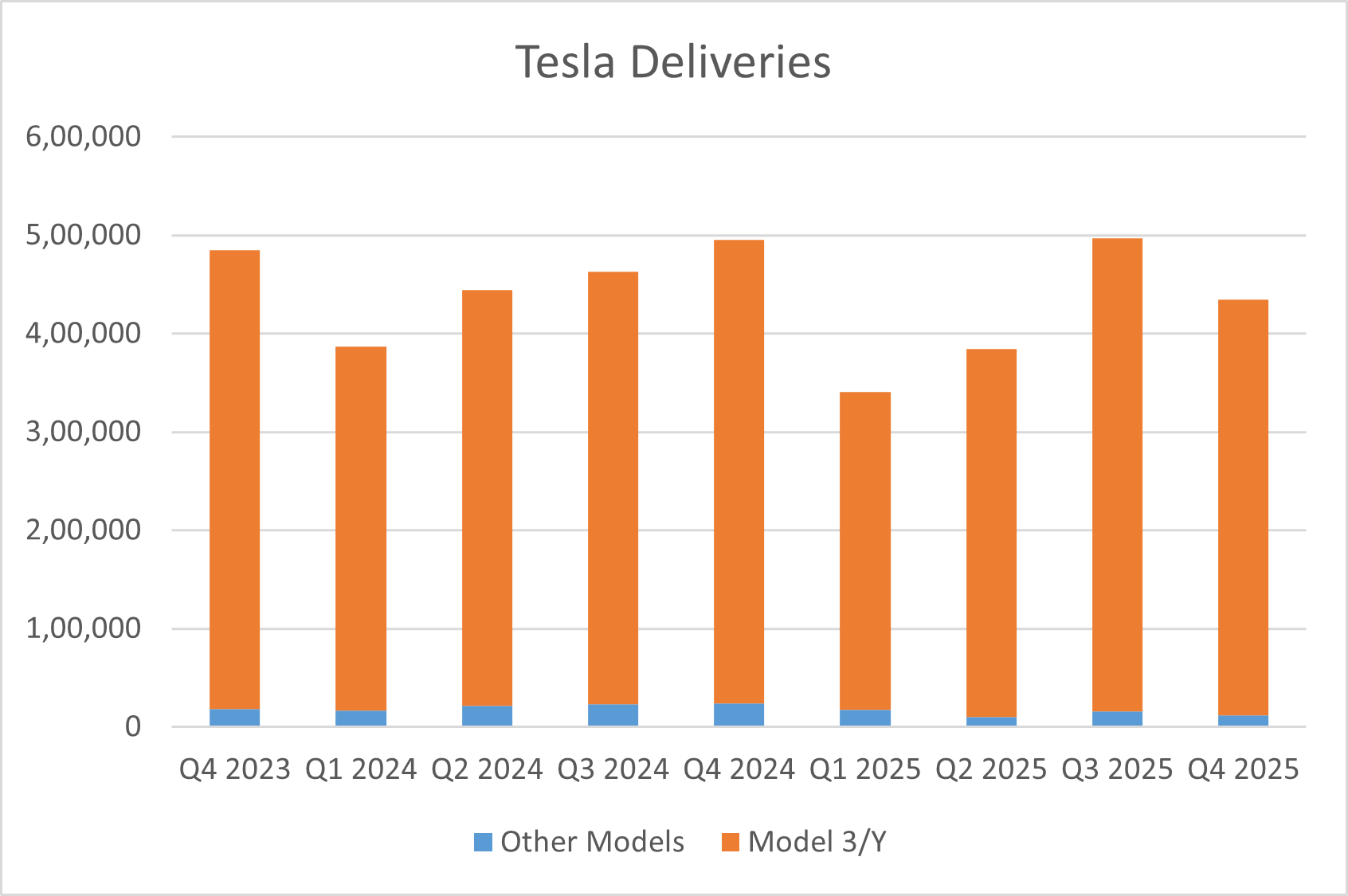
Tesla delivered 418,227 vehicles in the final three months of the year, a 16% drop compared to the same period in 2024. This figure was well short of the consensus estimate of 440,907 and also came in below the company’s own curated analyst consensus of 422,850 vehicles, which Tesla had unusually published on its website just days prior to “anchor” investor expectations.
The decline was largely attributed to a cooling in demand following the expiration of the $7,500 federal EV tax credit in the United States on September 30, which had caused a massive “pull-forward” of sales into the third quarter.
Tesla Reported Annual Fall in Deliveries
For the full year of 2025, Tesla delivered a total of 1.64 million vehicles, representing roughly an 8.5% decline from the 1.79 million units delivered in 2024. This downward trend highlights a period of significant transition and external pressure for the automaker. Throughout the year, Tesla faced intensifying competition from Chinese rivals like BYD and Xiaomi, as well as brand backlash in Western markets linked to CEO Elon Musk’s political engagement. To defend its market share, Tesla launched cheaper, stripped-down versions of the Model 3 and Model Y in the fourth quarter, though these moves were not enough to offset the loss of federal incentives and a softening global EV market.
Despite the slump in vehicle volume, Tesla’s energy storage business emerged as a major bright spot, achieving record deployments of 14.2 GWh in Q4 and 46.7 GWh for the full year. Investors appeared to look past the delivery miss, focusing instead on Musk’s pivot toward a “robotics and AI” future. The company’s stock remained resilient as leadership shifted the narrative toward “Epic 2026,” a year promised to be defined by the launch of the Cybercab and the start of “unboxed” manufacturing for a new, more affordable vehicle model. While the core automotive business is currently in a “trough,” the market seems to be betting on Tesla’s ability to reinvent itself as an autonomous technology powerhouse in the coming years.
BYD Surpasses Tesla to Become Biggest Seller of BEVs
Meanwhile, BYD has become the world’s biggest seller of battery electric vehicles (BEVs) as it sold 2.26 million cars last year, a year-over-year rise of 27.9%.
Notably, BYD surpassed Tesla’s total sales in 2022, even as the US EV giant retained the title of the biggest seller of BEVs. It hit yet another milestone when its 2024 revenues surpassed those of Tesla. BYD’s annual revenues rose 29% YoY to $107 billion last year, while Tesla’s revenues were around $97.7 billion. The steep rise in BYD’s sales was led by a record 4.27 million deliveries, which was well ahead of Tesla, which reported a YoY fall in its 2024 deliveries – the first in the company’s history.
Musk Had Scoffed at the Possibility of BYD Becoming a Competitor
Notably, in 2011, Musk laughed at the possibility of BYD becoming a competitor to Tesla. However, the Chinese company has proven critics wrong, and after becoming the biggest NEV seller in China, it is now expanding into international markets.
Notably, last year, Tesla faced a significant headwind when the $7,500 federal EV tax credit expired at the end of September 2025. This caused a massive surge of buyers in Q3 but left a vacuum in Q4. BYD, conversely, benefited from ongoing domestic incentives in China and aggressive expansion in Southeast Asia and South America.
While Tesla’s lineup remained largely stagnant, with consumers waiting for the “Cybercab”, BYD launched several high-volume models under its Ocean and Dynasty series. The high-end Yangwang brand also provided BYD with a foothold in the luxury segment, where margins are significantly higher.
Analysts have noted a growing “brand fatigue” for Tesla in Western markets, partly attributed to Musk’s political public-facing activities. In contrast, BYD’s neutral, “Build Your Dreams” branding has allowed it to scale rapidly in neutral markets like Mexico, Brazil, and Indonesia.
Tesla Is Pivoting To AI
Tesla is meanwhile pivoting to artificial intelligence (AI), and Musk characterized the current time as a “critical inflection point” for the company, stressing that Tesla is the “leader in real-world AI” and that the combination of FSD and Robotaxi will fundamentally change the nature of transport.
Cybercab Production To Begin in 2026
At Tesla’s annual meeting last year, the company unveiled Cybercab, the fully autonomous robotaxi designed without a steering wheel, pedals, or side mirrors. Musk confirmed that mass production is scheduled to begin in April 2026 at Gigafactory Texas, with the staggering goal of achieving a 10-second cycle time per vehicle on the production line, six times faster than the Model Y. This manufacturing efficiency is intended to allow for an annual production capacity of up to 2-3 million units, which is central to Tesla’s objective of deploying 1 million robotaxis in commercial service as part of Musk’s long-term compensation milestones.
Musk Believes Tesla Can Become the Biggest Company
While previously Musk said that Tesla would be more than the combined worth of Apple and Saudi Aramco, he has since been making even bolder predictions, and predicted that the company’s Optimus humanoid would make it a $25 trillion company. However, many Wall Street analysts don’t share Musk’s optimism and see the stock as highly overvalued.
At last year’s annual meeting, Musk stated the robot represents the future of the company, announcing the incredibly ambitious target of 1 million units delivered to meet one of his $1 trillion pay package requirements over the next decade. He projected that once production scales, the cost of an Optimus unit could be controlled to approximately $20,000, making it an affordable product that would dramatically expand Tesla’s economic scale. The robot’s debut performance, where it danced alongside Musk, was presented as a precursor to a future where Optimus could “eliminate poverty” and perform complex tasks, potentially better than humans.
#Tesla #Stock #Falls #Company #Misses #Delivery #Estimates