


WBD Again Rejects Paramount’s Offer Despite Larry Ellison’s Backstop
- Economy
- January 8, 2026
- No Comment
- 16
Please note that we are not authorised to provide any investment advice. The content on this page is for information purposes only.
The board of Warner Bros. Discovery (WBD) has once again rejected a takeover bid from Paramount Global in favor of its existing deal with Netflix, despite the offer being backed by billionaire Larry Ellison.
The primary difference between the two offers lies in scope and structure. The Netflix offer is a “friendly,” board-approved deal valued at approximately $72 billion (about $27.75 per share) and is a mix of cash and stock. Crucially, Netflix does not want the whole company; it is cherry-picking the “crown jewels,” specifically the Warner Bros. movie studios and HBO/Max, while leaving the “Global Networks” (like Newsportu, TNT, and Discovery) to be spun off or sold separately.
WBD Again Rejects Paramount’s Offer
In contrast, the Paramount Skydance bid is a “hostile” all-cash tender offer valued at $108.4 billion ($30 per share). Paramount is bidding for 100% of WBD, including its debt and its struggling linear cable networks.
Despite Paramount’s (PSKY) offer appearing more lucrative on paper ($30/share vs. $27.75/share), WBD’s board has categorized the Paramount bid as “inadequate” and “risky.” In its release, WBD said, “The PSKY Offer Is Not Superior, or Even Comparable, to the Netflix Merger.”
In its letter to shareholders, WBD said, “PSKY has repeatedly failed to submit the best proposal for WBD shareholders despite clear direction from WBD on both the deficiencies and potential solutions.”
The release added, “The WBD Board, management team, and our advisors have extensively engaged with PSKY representatives and provided it with explicit instructions on how to improve each of its offers. Yet PSKY has continued to submit offers that still include many of the deficiencies we previously repeatedly identified to PSKY, none of which are present in the Netflix merger agreement, all while asserting that its offers do not represent its ‘best and final’ proposal,” the board
The board’s primary concern is the debt. Paramount’s bid would require over $50 billion in new borrowing, creating a total debt load of $87 billion for the combined entity. WBD Chair Samuel Di Piazza Jr. warned that this “extraordinary amount of debt” creates significant risk that the deal could fail to close, leaving WBD in a weakened state.
Netflix Is a Much Bigger Company Than Paramount
In its release, it also pointed to the massive difference in the sizes of Paramount and Netflix. “PSKY is a company with a $14 billion market capitalization attempting an acquisition requiring $94.65 billion of debt and equity financing, nearly seven times its total market capitalization,” said WBD in its release.
Speaking with CNBC, Piazza said, “We have a signed merger agreement with Netflix, it’s a compelling value, a clear path to closing, and protections for our shareholders if something stops the close, whatever that might be.”
WBD Would Need to Pay Termination Costs to Netflix
The Board evaluated the significant financial penalties associated with accepting PSKY’s offer. Switching from the existing Netflix agreement would trigger a $2.8 billion termination fee and a $1.5 billion debt exchange penalty, alongside $350 million in incremental interest. These costs total $4.7 billion ($1.79 per share). Ultimately, these obligations would reduce PSKY’s effective regulatory termination fee from $5.8 billion to just $1.1 billion. By contrast, the Netflix transaction carries none of these financial burdens.
Meanwhile, Netflix has welcomed WBD’s decision to reject Paramount’s bid. In their statement, Netflix co-CEOs Ted Sarandos and Greg Peters said, “The WBD Board remains fully supportive of and continues to recommend Netflix’s merger agreement, recognizing it as the superior proposal that will deliver the greatest value to its stockholders, as well as consumers, creators and the broader entertainment industry.”
Why Netflix Wants to Buy WBD Assets?
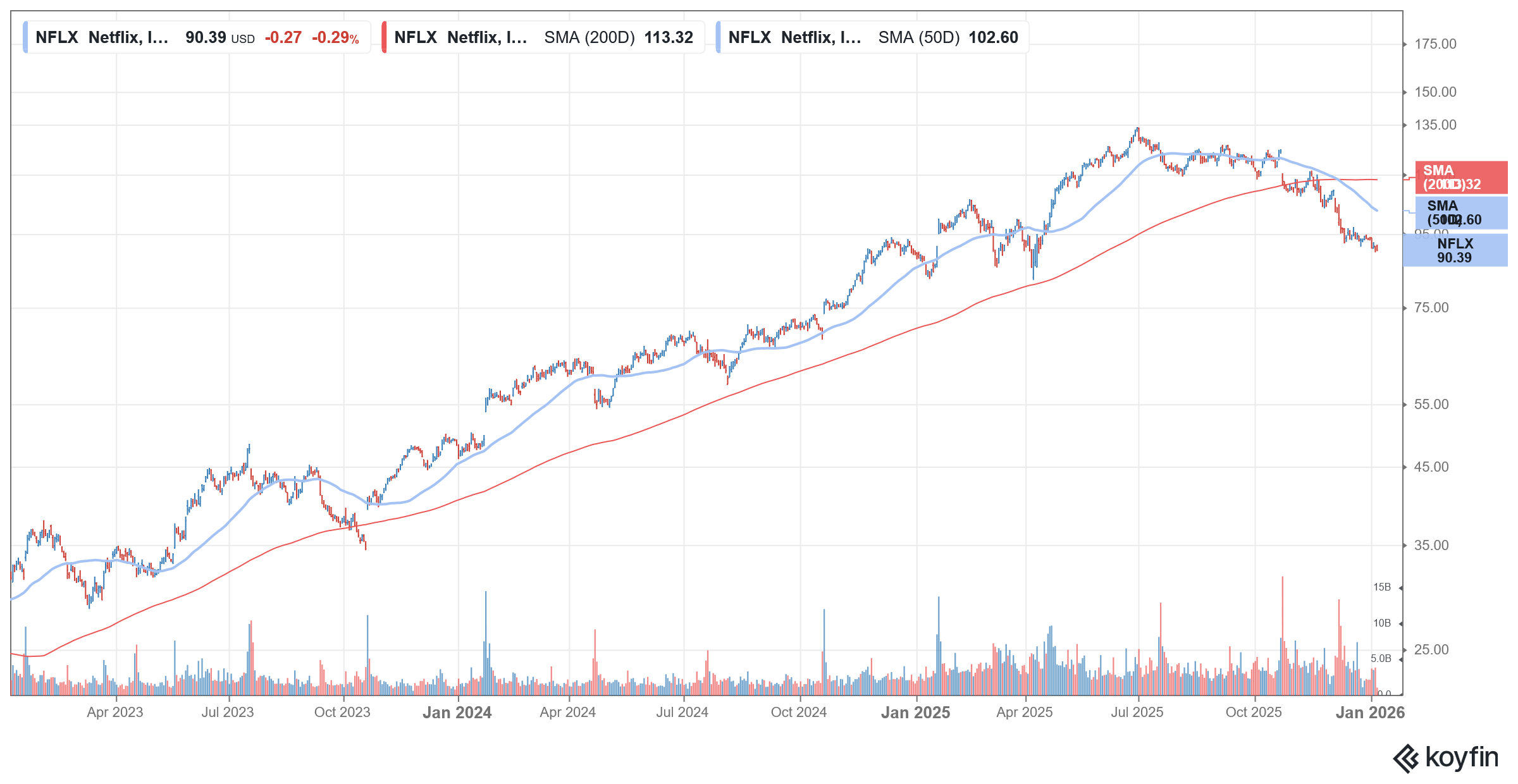
By owning this content, Netflix eliminates billions in future licensing costs and the risk of titles being pulled by rivals. The sheer volume of new content reduces “hit-rate risk” and strengthens the value proposition for its subscribers globally. As Netflix Co-CEO Ted Sarandos noted, the mission to “entertain the world” is better achieved by combining their “culture-defining titles” with Warner Bros.’ century-long legacy.
The merger combines the world’s largest streaming service by subscribers with HBO Max, a premium, critically acclaimed competitor. Analysts predict the combined entity will command over 21% of US streaming viewership, creating a significant market gap between Netflix and its remaining competitors, like Disney+ and Amazon.
Netflix expects to realize at least $2-3 billion in annual cost savings by the third year. This will come from eliminating duplicated services (like merging HBO Max into the Netflix platform), integrating production infrastructure, and optimizing back-office functions. This massive saving provides a financial cushion to reinvest in original content or pass savings on to consumers through bundled offerings.
Netflix will gain one of Hollywood’s most powerful, century-old production and global theatrical distribution studios. This vertical integration provides greater control over the entire production cycle, from greenlight to global release, enhancing studio capabilities and production capacity
Why is Paramount Interested in Buying Warner Bros. Discovery?
Paramount’s interest in acquiring Warner Bros. Discovery is driven by a desire for rapid survival through scale. In a landscape dominated by tech giants like Netflix, Amazon, and Disney, Paramount CEO David Ellison views this merger as the only way to transform Paramount from a “vulnerable legacy player” into a “global media titan.”
Streaming is currently a game of scale where only the largest survive. By combining Paramount+ with Max (HBO), the new entity would control the fourth-largest streaming library in the world, with over 207 million subscribers. This would give the combined company the leverage needed to negotiate better pricing with advertisers and reduce the “churn” (subscribers canceling) that plagues smaller services.
Moreover, the deal will create the most powerful sports broadcasting platform in history, making the combined company an essential partner for every cable and satellite provider in the world.
WBD Deal Would Face Regulatory Scrutiny
Meanwhile, there are potential antitrust hurdles in acquiring WBD. A Paramount-WBD merger would bring CBS News and Newsportu under the same corporate umbrella. Regulators often view the consolidation of major news organizations as a threat to “media plurality” and democratic discourse. This alone could force the divestiture of one of the networks.
Both companies own “legacy” film studios (Paramount Pictures and Warner Bros. Pictures). Reducing the number of major Hollywood studios from five to four would likely be seen as harmful to competition in film production and distribution, potentially driving up costs for theaters and reducing diversity in content.
#WBD #Rejects #Paramounts #Offer #Larry #Ellisons #Backstop