


Chemistry Nobel awarded to three scientists for their work on metal organic frameworks
- Science
- October 8, 2025
- No Comment
- 60
Georgina RannardScience reporter

 Reuters
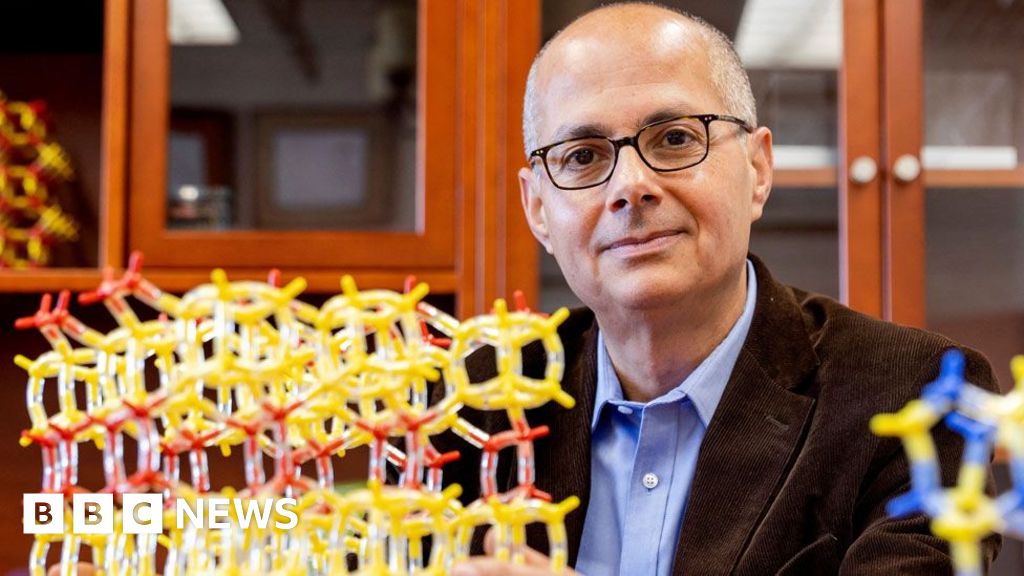
The Nobel Prize for Chemistry has been awarded to Susumu Kitagawa, Richard Robson, and Omar M Yaghi for their work on metal-organic frameworks.
The three scientists’ work could tackle some of the biggest problems on our planet, including capturing carbon dioxide to help tackle climate change and reducing plastic pollution using chemistry.
“I’m deeply honoured and delighted, thank you very much,” said Professor Kitagawa on the phone to a press conference after he was told the news.
“How long do I have to stay here? Because I have to go out for a meeting,” he added.
The three winners will share prize money of 11 million Swedish kronor (£872,000).
The scientists’ work is about how molecules can be built together into structures – or metal-organic frameworks (MOFs). The Nobel committee called it “molecular architecture”.
The men worked out how to build constructions with large spaces between the molecules, through which gases and other chemicals can flow.
These “rooms” can be used to capture and store chemicals that humans want to get rid of, including carbon dioxide in the atmosphere or so-called forever chemicals, also known as PFAS.
The scientists began working independently on the structures in the 1970s and 1980s. Prof Robson asked his university to drill holes into the lab worktops so that wooden balls – representing atoms – could be attached to wooden rods, representing chemical bonds.
So far MOFs have only been used on a small-scale, but companies are looking into whether they can be mass-produced.
One potential application is to break down harmful gases, including those used in nuclear weapons.
Companies are also testing whether they can be used to capture the planet-warming gas carbon dioxide from power stations and factories.
“Together, [the winners] have helped lay the foundations of and set the direction for one of the fastest-growing areas of fundamental research in modern chemistry,” said Professor Sheila Rowan, vice-president of the Royal Society, Britain’s national scientific academy.
The award is another indicator of the value of chemistry in addressing some of the planet’s hardest problems.
“Every year we see Nobel Prizes given to chemists who welcome the challenge of finding solutions to the biggest problems our global society faces – better healthcare, environmental protection, clean energy, and secure food and water for everyone,” said Dr Annette Doherty, president of the Royal Society of Chemistry in Britain.
 Getty Images
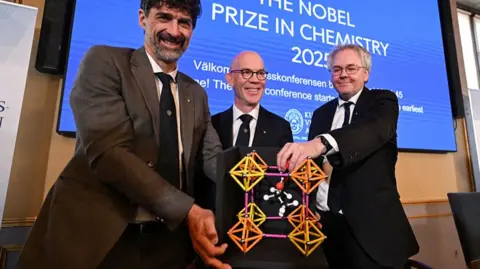
The announcement was made by the Royal Swedish Academy of Sciences at a news conference in Stockholm, Sweden.
Professor Kitagawa works at Kyoto University in Japan, Professor Richard Robson is at University of Melbourne, Australia, and Professor Omar M Yaghi is at the University of California, US.
Professor Kitagawa was motivated by the principle of “the usefulness of useless”, according to the Nobel committee. It reflected the philosophy of an ancient Chinese philosopher, Zhuangzi, who said that even if something did not bring immediate benefit, it could still turn out to be valuable.
Professor Yaghi was born in Amman, Jordan and raised in a single room with his siblings without electricity or running water, according to the Nobel committee.
He became captivated by molecular structures one day at school, and aged 15, he went to the US to study.
It is the third science prize awarded this week. On Tuesday John Clarke, Michel H. Devoret and John M. Martinis won the Physics Nobel for their work on quantum mechanics that paved the way for the quantum computer.
On Monday three scientists’ work on how the immune system attacks hostile infections won them the prize for medicine.
#Chemistry #Nobel #awarded #scientists #work #metal #organic #frameworks