



Ford Stock Rises to 52-Week Highs After Trump Announces Tariffs on Trucks
- Economy
- September 27, 2025
- No Comment
- 59
Please note that we are not authorised to provide any investment advice. The content on this page is for information purposes only.
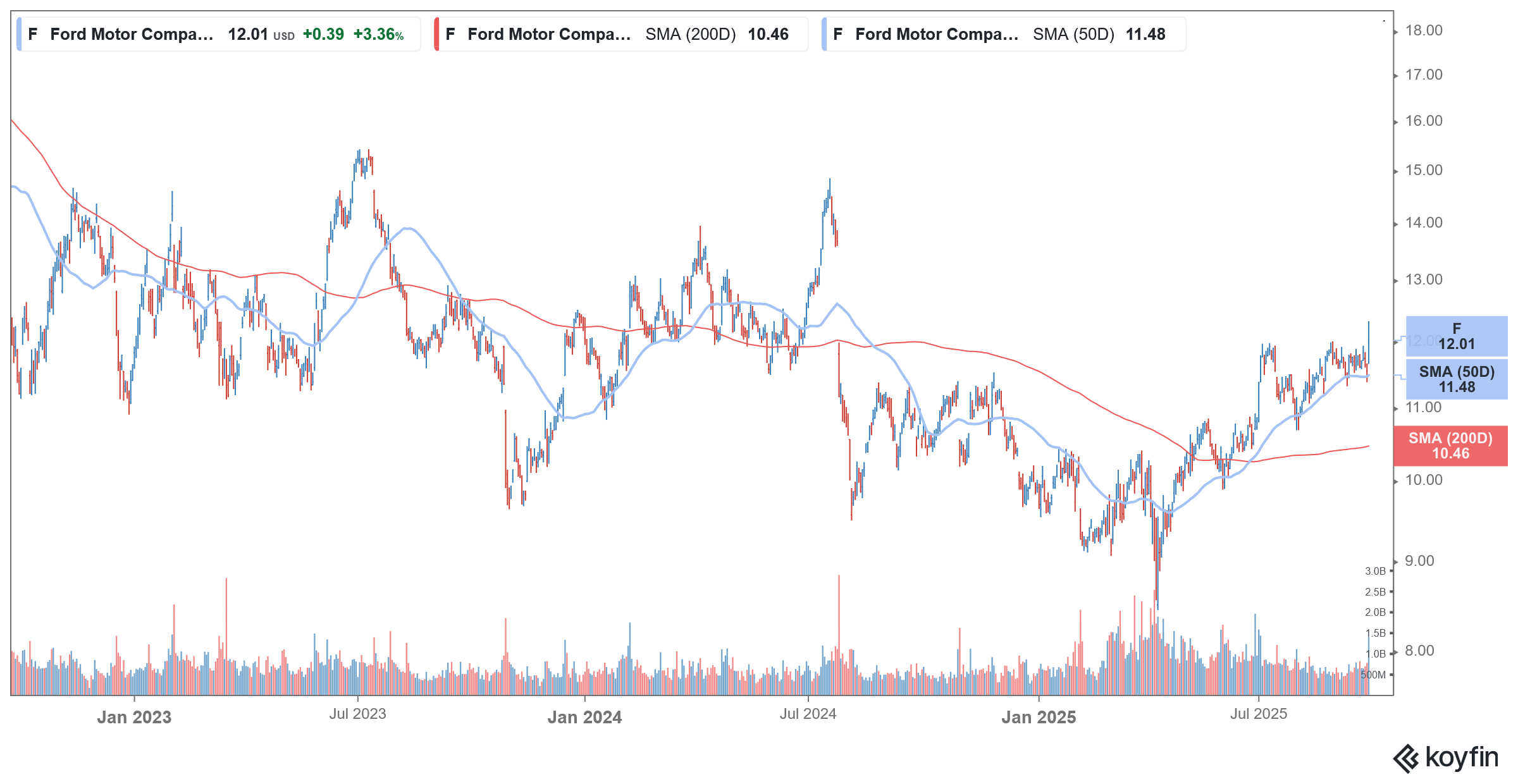
Ford stock rose to a 52-week high yesterday and closed above $12 after President Donald Trump announced a 25% tariff on imported trucks. While Ford only sells a few class seven trucks and chassis, and won’t benefit much from these tariffs, the stock still rose as it crossed key technical levels.
“In order to protect our Great Heavy Truck Manufacturers from unfair outside competition, I will be imposing, as of October 1st, 2025, a 25% Tariff on all ‘Heavy (Big!) Trucks’ made in other parts of the World,” said Trump in a Truth Social post Thursday.
The North American Automotive Industry Is Quite Integrated
Notably, Trump’s tariffs have been a headwind for the automotive industry, which relies on suppliers across the world, particularly across the Northern and Southern borders. The automotive industry in North America is quite integrated, and the tariffs are disruptive for US auto majors. Notably, Canada, Mexico, and the US were covered under the NAFTA (North American Free Trade Agreement), which Trump renegotiated in his first tenure. In July 2020, the USMCA (United States-Mexico-Canada Agreement) replaced the NAFTA, which had come into effect in 1994. The USMCA is also scheduled for a review in July 2026.
For years, the US automotive industry benefited from lower production costs in Mexico, and global auto giants set up plants in that country. The tariffs are, however, set to negatively impact companies like Ford, General Motors, and Volkswagen as they all have manufacturing footprints in Mexico and Canada.
General Motors, meanwhile, is more exposed to the tariffs than Ford, as apart from importing parts and vehicles from Mexico and Canada, it also imports finished cars from South Korea and China into the US.
Ford Lowered Its Guidance Due to Tariffs
While Ford had previously withdrawn its guidance due to the uncertainty over tariffs, the company reinstated its guidance during the Q2 earnings call while warning of a gross hit of $3 billion from the tariffs. The company expects to mitigate $1 billion of the impact, and the net hit to its bottomline would be $2 billion this year.
Auto and Steel Tariffs Are a Headwind for US Automakers
In addition to the tariffs on imports of cars and auto parts, the Trump administration has imposed a tariff on steel and aluminum imports, which are two of the key raw materials for the automotive industry. While no automaker has issued a specific profit warning on the impact of these tariffs, in 2018, Ford had warned of a hit of $1 billion between 2018 and 2019 from the steel and aluminum tariffs that Trump had imposed in his first tenure. Notably, back then, Trump slapped a 25% tariff on steel imports and a 10% tariff on aluminum imports. This time, he started with a 25% tariff on both metals, which he is now raising to 50%.
US steel prices are already among the highest globally, and the tariffs tend to embolden domestic companies to raise prices further, making it even costlier to make cars in the US. Ford executives have stated that the structure of some tariffs (like those on raw materials and parts) puts US-based automakers at a competitive disadvantage compared to foreign rivals that might face lower tariff rates on finished imported vehicles.
Ford Doubles Down on Affordable EVs
Meanwhile, even as Ford’s electric vehicle (EV) business continues to be a cash guzzler and is expected to report an operating loss of $5 billion this year, the company is doubling down on affordable models.
In a move Ford CEO Jim Farley has dubbed the company’s “Model T moment,” last month the company announced its next-generation electric vehicle architecture: the Ford Universal EV Platform and a revolutionary new manufacturing process, the Ford Universal EV Production System. This initiative is a high-stakes, multi-billion-dollar bet aimed at slashing costs to deliver a new family of affordable, profitable, and feature-rich electric vehicles, starting with a $30,000 midsize pickup truck.
The new Universal EV Platform is scalable and is expected to underpin a full family of vehicles, including SUVs, crossovers, and commercial vans, with the ultimate goal of making Ford’s electric vehicle business profitable and competitive in the mass market.
Ford Has Been Bogged Down by Recall and Warranty Issues
Even as Ford has been pivoting to EVs and hybrids, the company continues to face recurring recalls, which take a toll on its profits. In July, it disclosed costs of around $570 million related to the recall of 694,271 crossover SUVs due to a fuel leakage issue.
Fuel injectors in affected vehicles may crack, which could lead to fuel leakage into the engine compartment that poses fire risks. The NHTSA estimates that 0.3% of recalled vehicles, which include 2021–2024 Bronco Sport and 2020–2022 Escape models, may have the defect. Italy-based Dumarey Flowmotion Technologies supplied these injectors to Ford.
Disturbingly, this was not a new problem for these models. Ford has attempted to address this defect through multiple previous recalls in 2022 and 2024, primarily offering software updates and drain tube installations. However, a year-long investigation by the NHTSA determined that these “fixes” were inadequate as they failed to address the root cause – the faulty injectors themselves. Eight vehicles reportedly experienced under-hood fires due to this issue, with six of them not having received the recommended software updates.
Recall Costs Have Been an Overhang for Ford Stock
Separately, Ford pulled back over 850,000 vehicles, including popular SUVs like the Bronco (2021-2023), Explorer (2021-2023), Expedition (2022), and Lincoln Aviator (2021-2023), as well as various F-Series trucks and the Mustang. The core of this recall lies with the low-pressure fuel pump, which can fail due to internal contamination of the jet pump. This can lead to a loss of fuel pressure and flow, potentially causing the engine to stall while driving and increasing the risk of a crash.
Notably, recall and warranty costs have been a headwind for Ford. While the company has said that it is a legacy issue, they are quite frequent and many times impact newer vehicles. Recall costs have also hit Ford stock, and the company hasn’t been able to get over the recurring issue.
#Ford #Stock #Rises #52Week #Highs #Trump #Announces #Tariffs #Trucks