

Humans cuddle up to meerkats in the monogamy rankings
- Science
- December 10, 2025
- No Comment
- 32
Helen BriggsEnvironment correspondent

 Getty
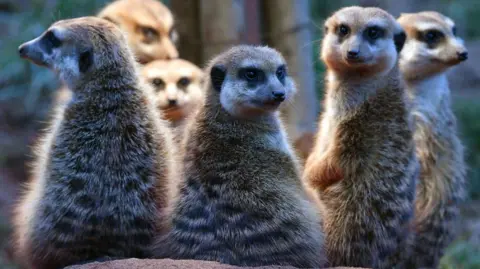
GettyHumans are a bit like meerkats when it comes to pairing up, according to a study that examined the monogamous lifestyles of different species.
In our romantic life, we more closely resemble these social, close-knit mongooses than we do our primate cousins, a “league table” of monogamy compiled by scientists suggests.
At 66% monogamous, humans score surprisingly highly, far above chimps and gorillas – and on a par with meerkats.
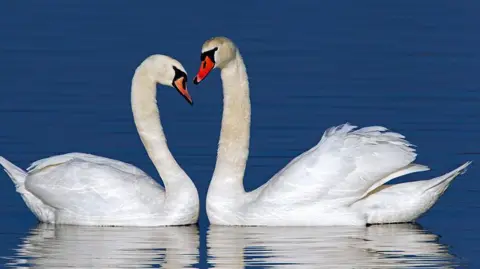
However, we are by no means the most monogamous creature. Top spot goes to the Californian mouse – rodents that form inseparable, lifelong bonds.
 Getty
Getty“There is a premier league of monogamy, in which humans sit comfortably, while the vast majority of other mammals take a far more promiscuous approach to mating,” said Dr Mark Dyble at the University of Cambridge.
In the animal world, pairing up has its perks, which may be why it has evolved independently in multiple species, including us. Experts have proposed various benefits to so-called social monogamy, where mates match up for at least a breeding season to care for their young and see off rivals.
Dr Dyble examined several human populations throughout history, calculating the proportions of full siblings – where individuals share the same mother and father – compared with half-siblings, individuals who share either a mother or a father, but not both. Similar data was compiled for more than 30 social monogamous and other mammals.
Humans have a monogamy rating of 66% full siblings, ahead of meerkats (60%) but behind beavers (73%).
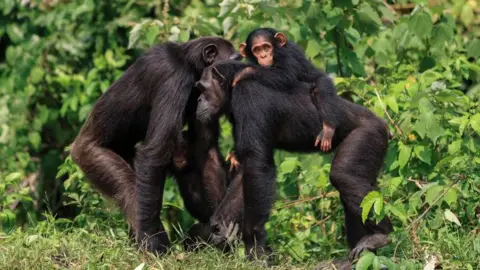
Meanwhile, our evolutionary cousins fall at the bottom of the table – with mountain gorillas at 6% rating, while chimpanzees come in at just 4% (alongside the dolphin).
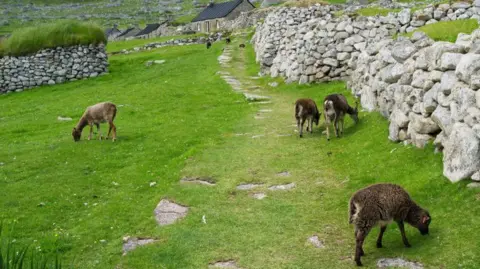
In last place is Scotland’s Soay sheep, where females mate with multiple males, with 0.6% full siblings. The Californian mouse came top, at 100%.
 Getty
GettyHowever, being ranked alongside meerkats and beavers doesn’t mean our societies are the same – human society is poles apart.
“Although the rates of full siblings we see in humans are most similar to species like meerkats or beavers, the social system that we see in humans is very different,” Dr Dyble told BBC News.
“Most of these species live in colony-like social groups or perhaps live in solitary pairs that go around together. Humans are very different from that. We live in what we call multi-male, multi-female groups, within which we have these monogamous, or pair-bonded, units.”
 Getty
GettyDr Kit Opie at the University of Bristol, who is not connected with the study, said this is another piece in the puzzle over how human monogamy arose.
“I think this paper gives us a very clear understanding that across time and across space humans are monogamous,” he said.
“Our society is much closer to chimps and bonobos – it just happens that we’ve taken a different route when it comes to mating.”
The new study is published in the Proceedings of the Royal Society: Biological Sciences.
#Humans #cuddle #meerkats #monogamy #rankings