



Meteorite that hit home is older than Earth, scientists say
- Science
- August 10, 2025
- No Comment
- 68
A meteorite that crashed into a home in the US is older than planet Earth, scientists have said.
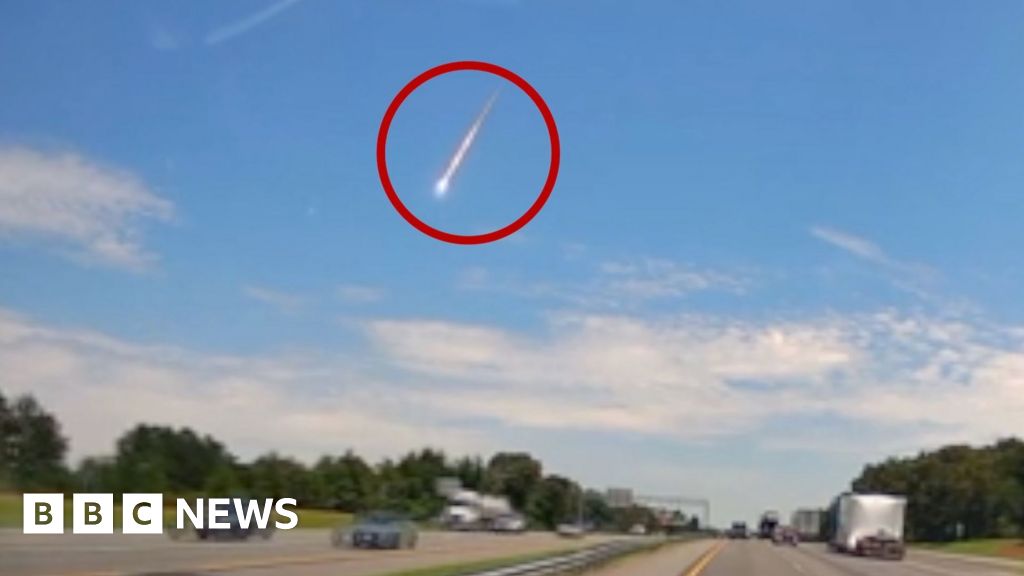
The object flew through the skies in broad daylight before exploding across the state of Georgia on 26 June, Nasa confirmed.
Researchers at the University of Georgia examined a fragment of the rock that pierced the roof of a home in the city of McDonough.
They found that, based on the type of meteorite, it is expected to have formed 4.56 billion years ago, making it roughly 20 million years older than Earth.
Residents in Georgia and nearby states reported hundreds of sightings and a loud booming noise when the fireball tore through the skies.
The rock quickly diminished in size and speed, but still travelled at least 1 km per second, going through a man’s roof in Henry County.
Multiple fragments that struck the building were handed over to scientists, who analysed their origins.
“This particular meteor that entered the atmosphere has a long history before it made it to the ground of McDonough,” Scott Harris, a geologist at the University of Georgia, said.
Using optical and electron microscopy, Harris and his team determined the rock was a chondrite – the most abundant type of stony meteorite, according to Nasa – which meant that it was approximately 4.56 billion years old.
The home’s resident said he is still finding pieces of space dust around his home from the hit.
The object, which has been named the McDonough meteorite, is the 27th to have been recovered from Georgia.
“This is something that used to be expected once every few decades and not multiple times within 20 years,” Harris said.
“Modern technology, in addition to an attentive public, is going to help us recover more and more meteorites.”
Harris is hoping to publish his findings on the composition and speed of the asteroid, which will help to understand the threat of further asteroids.
“One day there will be an opportunity, and we never know when it’s going to be, for something large to hit and create a catastrophic situation. If we can guard against that, we want to,” he said.
#Meteorite #hit #home #older #Earth #scientists