




Morgan Stanley Upgrades GM While Turning Bearish On EV Stocks
- Economy
- December 12, 2025
- No Comment
- 49
Please note that we are not authorised to provide any investment advice. The content on this page is for information purposes only.
Earlier this week, Morgan Stanley upgraded General Motors (NYSE: GM) stock from Equal Weight” to “Overweight” and increased its 12-month price target to $90 from the previous $54.
Morgan Stanley Upgrades GM Stock
Morgan Stanley’s new automotive analyst, Andrew Percoco, cited several compelling reasons for the upgraded forecast, highlighting GM’s strong execution and the advantageous macro environment. These include
- Exceptional Operational Execution: The firm praised GM for its “industry-leading U.S. inventory and incentive discipline,” suggesting the company is effectively managing supply to maintain pricing power and profit margins.
- Favorable Mix Shift to High-Margin Vehicles: GM’s focus on its core business of high-margin trucks and SUVs is expected to drive long-term revenue and profitability, a strategy that is proving highly effective in the current market.
- Strategic Capital Discipline: Morgan Stanley noted GM’s improved capital allocation, including the strategic realignment of its electric vehicle (EV) and autonomous vehicle (AV) plans and the completion of a $10 billion accelerated share repurchase program. The company has also raised its dividend for four consecutive years.
- Shifting Policy Environment: The analyst points to a reduction in policy uncertainty and the anticipated sunsetting of the federal EV tax credit. This shift is expected to create an “EV winter” through 2026, which is seen as an advantage for traditional automakers like GM, whose strong internal combustion engine (ICE) vehicle sales will likely surge in the interim.
- Anticipated Economic Tailwinds: Reduced policy uncertainty and potential rate cuts in the second half of 2026 are expected to improve vehicle affordability, further boosting demand for GM’s core product lineup.
Morgan Stanley Downgrades Rivian and Tesla
The upgrade places General Motors in a favorable light compared to its pure-play EV competitors. While simultaneously downgrading rivals like Tesla and Rivian. Morgan Stanley’s move underscores a belief that GM’s balanced approach, leveraging its profitable ICE business to fund a more disciplined transition into next-generation mobility, is the most prudent path to shareholder value in the current economic cycle.
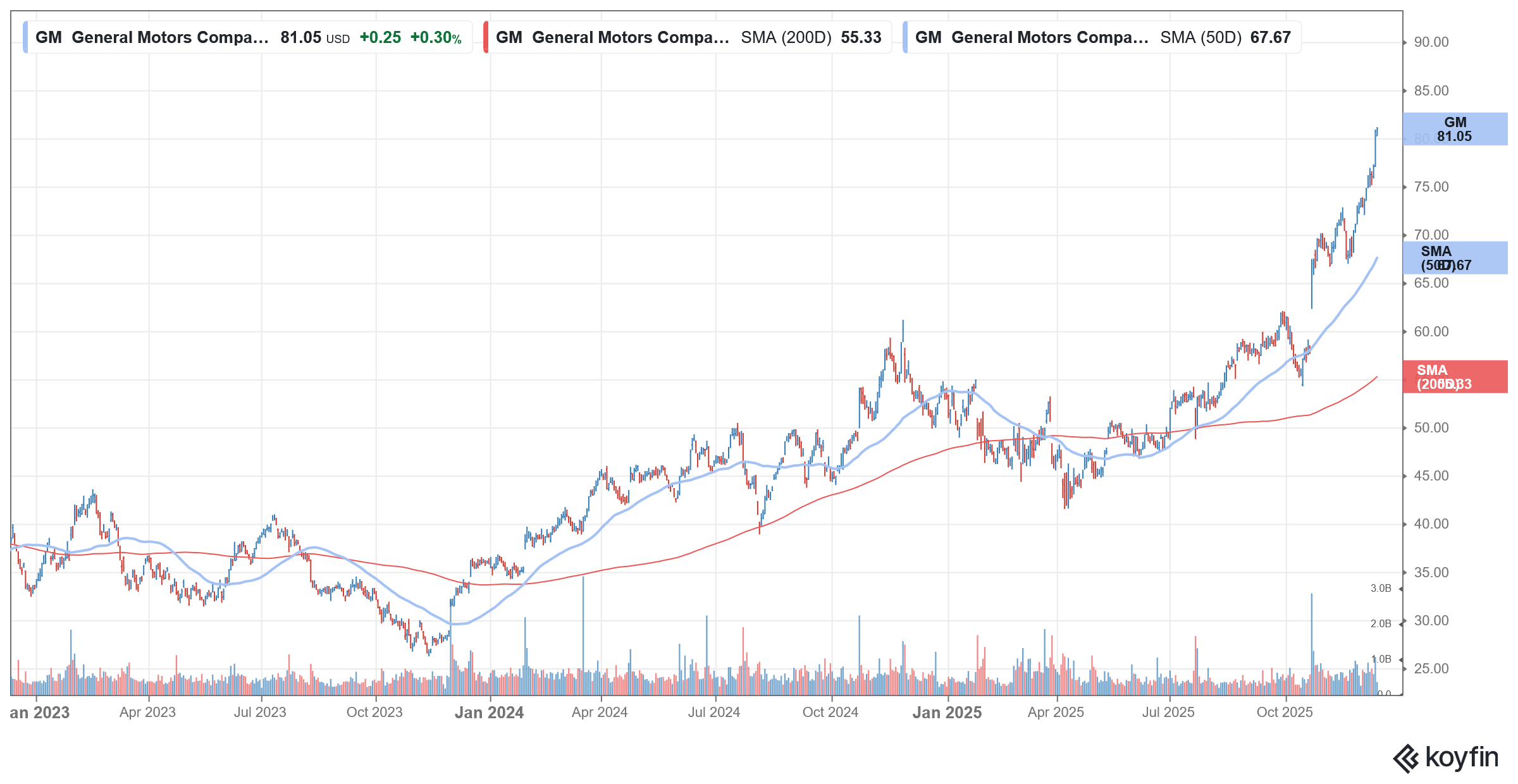
Notably, with gains of 57% in 2025, GM stock is not only outperforming the broader markets and Detroit peer Ford but also EV companies like Tesla and Rivian that are reeling under the slowdown in the US EV industry.
EV Industry Slowdown
The company is not immune to the EV slowdown, though, and recorded a $1.6 billion special charge in Q3 2025 primarily related to the strategic realignment of the company’s EV production capacity. This charge included approximately $1.2 billion in non-cash impairments and about $400 million in cash supplier cancellation costs, signaling the company’s move to “right-size” its EV assets amid a more tempered pace of electric vehicle adoption than initially projected.
Notably, GM had forewarned about the charge ahead of the Q3 report. GM’s decision stems from a re-evaluation of its prior aggressive investment and production commitments for EVs. The company specifically cited changes in US government policy as a key factor expected to slow the pace of EV adoption. These policy shifts include the termination of certain consumer tax incentives for EV purchases and the reduction in the stringency of emissions regulations. The tax incentives, which had previously spurred sales, expired at the end of September 2025, resulting in a decline in consumer demand.
GM Is Doubling Down on US Production
Meanwhile, Morgan Stanley expects GM’s proactive investments, including a $4 billion commitment to U.S. operations for supply chain realignment, to be a smart move that will help mitigate future tariff exposure.
Notably, GM is more exposed to tariffs compared to Ford, as it imports not only parts and vehicles from Mexico and Canada but also finished cars from South Korea and China into the US. However, the company has been trying to mitigate the impact of the tariffs by increasing domestic content. As part of that initiative, it announced a capex of $4 billion earlier this year, which would help it in onshoring production at plants in Kansas, Tennessee, and Michigan.
Goldman Sachs also raised General Motors’ Target Price
Goldman Sachs has shown increased confidence in GM, raising its 12-month price target for the automaker’s stock to $93 while maintaining a ‘Buy’ rating. This move comes as part of a general wave of bullish sentiment from Wall Street analysts for the company.
GM Raised Its 2025 Guidance
Meanwhile, GM posted $48.6 billion in revenue in Q3, which was nearly flat compared to the same period in the prior year, yet comfortably exceeded market expectations of $45.26 billion. The company’s adjusted pre-tax profits came in at $3.38 billion, which was well ahead of the $2.72 billion that analysts were expecting.
However, the headline figure for GAAP net income attributable to stockholders was $1.3 billion, representing a significant drop of over 56% year-over-year, largely due to the one-time charges discussed above.
GM raised its full-year 2025 guidance, citing improved clarity on the impact of tariffs and a more contained outlook for EV-related losses as the main drivers. It now forecasts its full-year adjusted EBIT to be between $12 billion and $13 billion, an increase from the previous range of $10 billion-$12.5 billion. Similarly, the full-year adjusted EPS is now expected to be between $9.75 and $10.50 versus the previous guidance of $8.25 to $10. GM also raised its automotive free cash flow guidance to between $10 billion-$11 billion, up from the previous guidance of $7.5 billion-$10 billion.
GM Expects 2026 Earnings To Be Higher Than 2025
General Motors expects its 2026 earnings to be higher than this year. “Looking ahead to 2026, we have multiple levers to carry our current momentum forward, including progress on [electric vehicle] losses, warranty costs, tariff offsets, regulatory requirements, and fixed costs,” said CFO Paul Jacobson during the earnings call. He added, “As a result, we expect next year to be even better than 2025.”
In the Q3 shareholder letter, Barra said, “Looking ahead, our top priority is to restore North America to our historical 8–10% EBIT-adjusted margins. We are focused on driving EV profitability, maintaining production and pricing discipline, managing fixed costs, and further reducing tariff exposure.”
#Morgan #Stanley #Upgrades #Turning #Bearish #Stocks