




Northern Lights sightings possible as huge solar flare spotted
- Science
- October 4, 2024
- No Comment
- 134

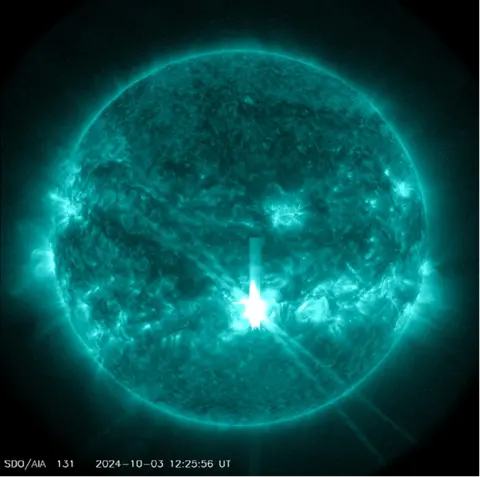 Met Office
A huge solar flare, the largest since 2017, has been spotted erupting from the Sun’s surface.
Solar flares are made up of electromagnetic radiation that travel from the Sun at the speed of light and can reach Earth in about eight minutes.
They can disrupt some radio communications and satellites but most of us are unlikely to see those effects.
There is also a chance that northern latitudes could see the Northern Lights this weekend as two geomagnetic storms are predicted to hit Earth.
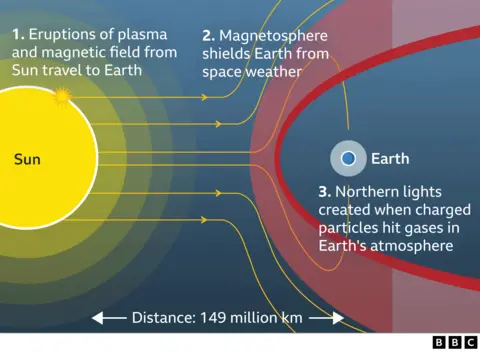
Solar flares do not cause the Northern Lights. They are caused by a phenomenon called coronal mass ejections (CMEs) that erupt from an active sun spot.
Combined with flares, they can create solar storms that interact with Earth’s magnetic field or magnetosphere.
The CMEs spew out plasma and magnetic field, and up to billions of tons of material, that can hit Earth. As our magnetosphere repels the storm, it creates the aurora.
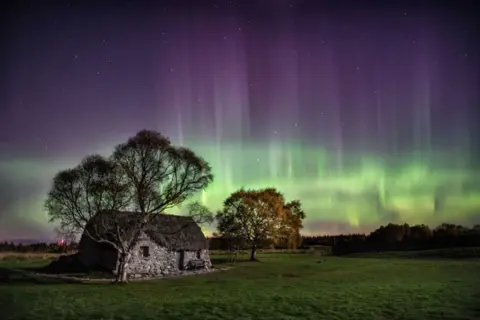
“There is the potential for a coronal mass ejection to arrive at Earth late on Friday or early on Saturday, which could lead to visible aurora for Scotland, Northern Ireland and parts of northern England,” said Met Office Space Weather Manager Krista Hammond.
 Getty Images
A second CME is likely to hit Earth on Saturday and Sunday, associated with the solar flare which is rated X9.
That means “enhanced auroral visibility is possible further south across central England and similar latitudes, though cloud and rain could hamper viewing potential for some,” says Krista Hammond.
In the US, aurora might be seen in the northern states, and from the mid-west to Oregon, according to NOAA’s Space Weather Prediction Centre.
The X9 solar flare emitted is the largest categorised by Nasa. The smallest is B, followed by C, M, and X. The scale ranks from 1 to 9, so X9 is the most powerful in Nasa’s ranking.
More aurora likely this year
The Sun is approaching something called “solar maximum” which is when it is most active in an 11-year cycle.
As the Sun continues in this active phase, Earth is more likely to be hit by strong geomagnetic storms, meaning there is higher chance of seeing the Aurora Borealis for the next few months.
But scientists only know if solar maximum has happened six months after the event, because they use six months of data analysing the intensity and frequency of sun spots.
Current predictions suggest we could reach solar maximum at the end of 2024 or early 2025.
What is the weather forecast in the UK
BBC weather presenter Simon King says the UK weather does not look good for people hoping to spot the aurora this weekend.
“It would just be the far north-east of Scotland getting the odd break in the cloud for a short time,” he says.
“If activity turns out to be a bit stronger, the best of the clear skies on Friday night will be more towards central and south England.
He says clouds may hamper viewings on Saturday night despite the evening starting with a lot of clear skies.
#Northern #Lights #sightings #huge #solar #flare #spotted