



The AI-Fueled Chip Shortage Could Raise Smartphone Prices, Counterpoint Research Warns
- Economy
- December 16, 2025
- No Comment
- 44
Please note that we are not authorised to provide any investment advice. The content on this page is for information purposes only.
Counterpoint Research has warned that the insatiable demand for chips driven by the artificial intelligence (AI) boom could lead to a surge in smartphone prices and a subsequent decline in global shipments in 2026.
The core of the issue lies in the massive reallocation of semiconductor production capacity to service the burgeoning AI data center industry, which requires vast quantities of advanced memory chips.
Counterpoint Sees Smartphone Volumes Falling in 2026
The report highlights a “seismic shift” in the supply chain as major chip manufacturers prioritize the production of High-Bandwidth Memory (HBM) and other advanced memory types essential for AI accelerators like those from Nvidia. This focus is leading to a tightening of supply for more conventional memory components, such as DRAM and NAND flash, which are critical to consumer electronics like smartphones and PCs.
Counterpoint Research’s latest data projections indicate that memory prices could rise significantly, with estimates suggesting a continuation of the upward trend well into 2026. This translates directly to a jump in the Bill of Materials (BoM) cost for smartphone manufacturers.
Lower End of Smartphone Market Is Expected To Be Hit the Hardest
The overall cost of smartphone components is expected to increase by 10% to 25%. The low-end market (under $200) is projected to be hit hardest, with BoM costs potentially increasing by 20%–30%. “In the lower price bands, steep price increases on smartphones are not sustainable,” said Counterpoint’s Senior Analyst Yang Wang. Wang added, “And if cost pass-through isn’t possible, OEMs will start pruning parts of their portfolios – that’s actually what we are starting to see with significantly reduced volumes of low-end SKUs.”
However, the mid- and high-end segments are estimated to see component price increases of 10%–15%. Consequently, Counterpoint forecasts that the global average selling price (ASP) for handsets is set to rise by an estimated 6.9% next year.
Apple and Samsung Are Better Placed Than Other Smartphone Companies
In its report, Counterpoint said that Apple and Samsung are best placed to navigate the challenging market. It added, “But it will be tough for others that don’t have as much wiggle room to manage market share versus profit margins. We will see this play out especially with the Chinese OEMs as the year progresses.”
However, according to Counterpoint, other smartphone companies are looking to mitigate the impact of higher chip costs through other strategies. “In some models, we are seeing downgrades of components like camera modules and periscope solutions, displays, audio components and, of course, memory configurations,” said Senior Analyst Shenghao Bai. Bai added, “Other tactics include reusing old components, streamlining the portfolio, and pushing consumers to higher-specification ‘Pro’ variants and adopting new designs to stimulate upgrades.”
Counterpoint Expects Apple to Become The Biggest Smartphone Company
Notably, Counterpoint’s report comes a few days after it predicted that Apple would surpass Samsung Electronics as the world’s leading smartphone manufacturer by annual shipment volume in 2025.
In that report, Counterpoint projected Apple’s iPhone shipments to grow by 10% year-over-year, significantly outpacing the 4.6% growth forecast for Samsung’s Galaxy device. Counterpoint estimated that Apple will capture 19.4% smartphone market share this year, ahead of Samsung’s 18.7%.
Counterpoint forecasted that Apple will hold the position of the leading smartphone company until 2029 and will widen the gap with Samsung. The research firm projected that a strong product pipeline, including the rumored launch of a more budget-friendly iPhone 17e model and the anticipated debut of Apple’s first foldable iPhone in the coming years, would help drive volumes for Apple, whose shipments were tepid over the last couple of years.
iPhone Revenues Hit a Record High in September Quarter
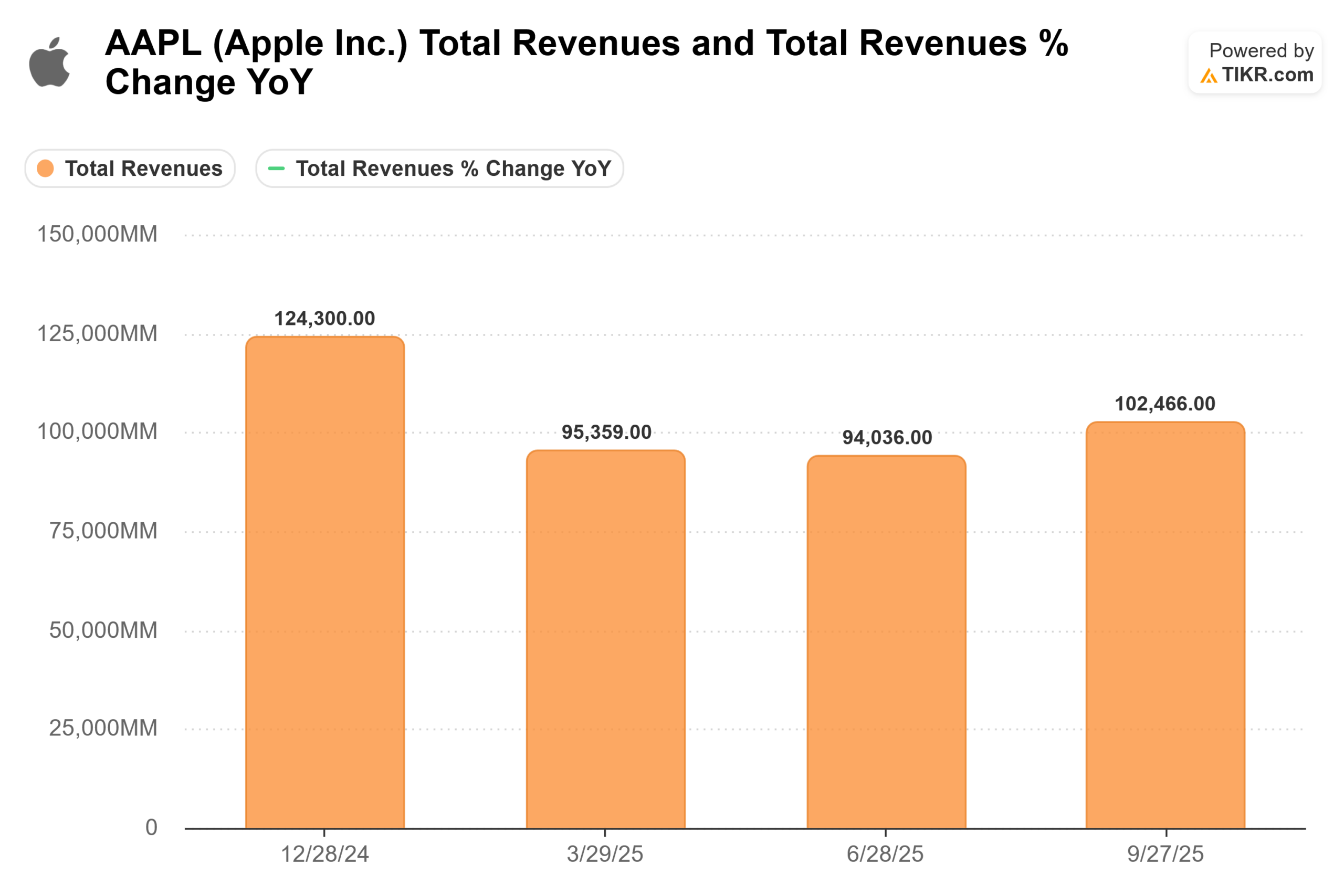
Apple closed its fiscal year 2025 with a stronger-than-expected fourth quarter, reporting a September-quarter revenue record of $102.5 billion, an 8% increase year-over-year (YoY). This robust performance was largely driven by the continued strength of the iPhone business and a record-breaking quarter for the Services division.
The company’s net quarterly profit soared to $27.5 billion, or $1.85 per diluted share, significantly surpassing Wall Street expectations. This solidifies Apple’s position as it heads into the crucial holiday season.
The iPhone segment demonstrated resilience and growth, largely attributed to the initial, highly successful launch of the iPhone 17 lineup (including the iPhone 17, iPhone 17 Pro, iPhone 17 Pro Max, and the new iPhone Air).
iPhone revenue for Q4 2025 reached $49.03 billion, marking a 6% YoY increase and setting a September-quarter record. While the quarter only included a few weeks of sales for the new models, early demand for the iPhone 17 series, particularly the premium Pro/Pro Max models, was quite strong. Initial sales in key markets like the US and China were reportedly tracking 14% above the prior year’s launch, underscoring the success of the new design, improved cameras, and the new A19 Pro chip.
Apple’s Installed Device Base Rose to Record High
CEO Tim Cook highlighted that the installed base of active devices reached a new all-time high across all product categories, which is a critical long-term driver for Services revenue. The segment saw strong growth across most major markets, with Europe, Japan, and the Rest of the Asia Pacific posting healthy increases. However, revenue in Greater China saw a slight dip, a soft spot attributed to competitive pressures and supply timing issues.
#AIFueled #Chip #Shortage #Raise #Smartphone #Prices #Counterpoint #Research #Warns