



The old Swansea railway that was the world’s first passenger line
- International
- September 21, 2025
- No Comment
- 59
Peter Shuttleworth and
Garry OwenBBC Wales

 AFP via Getty Images
The Orient Express, the Trans-Siberian Railway or even the Hogwarts Express. Every train journey in history can trace its origins back to one humble railway by the seaside.
It may not have felt like much at the time, but when a horse-drawn wagon started trundling down a Welsh tramway in 1807 it was a significant moment in history.
The world’s first passenger railway service had left the world’s first station with a couple of hardy souls making the five-mile trip around Swansea Bay.
“Now there’s trains and stations in virtually every corner of the world – but it all started in south Wales,” said TV rail historian, Tim Dunn.
This week it will be 200 years since what has often been described as the birth of the modern railway – when the Stockton to Darlington public line in north-east England became the world’s first to use steam locomotives.
But by September 1825, the Oystermouth Railway in Swansea had already been running for 18 years, in what the Guinness Book of Records acknowledges as the world’s first fee-paying passenger railway line.
“The reason the Stockton and Darlington has become famous – perhaps unjustly – and the reason we’re celebrating 200 years of the railway this year is because of a PR exercise by that railway company years ago,” added Tim.
“But really, it all started in Swansea.”
 Getty Images
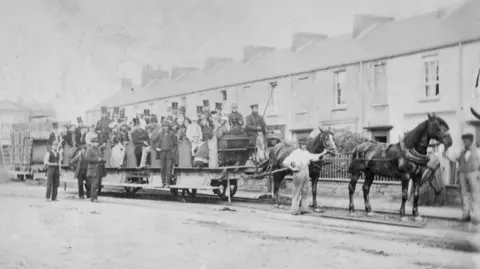
Horses pulled wagons three times a day between The Mount in Swansea and the seaside village of Oystermouth.
The Mount became the world’s first recorded railway station – but forget posh coffee shops or supermarkets, because there wasn’t even a ticket office.
In fact, historians don’t think there was even a platform. It is thought that passengers clambered up onto the wagon from a mound by the side of the track.
Today, what was The Mount station is a patch of grass alongside a nondescript dual carriageway in the middle of Swansea.
“It is often underplayed, but there were big railways firsts in Wales that are of huge significance,” added Tim.
 Swansea Museum | Swansea Council
“They might not have changed the world, but they helped shape the world. Wales needs to own and celebrate that more,” Tim said.
The Oystermouth Railway came three years after another railway first in south Wales – when pioneering inventor Richard Trevithick worked out how to move a locomotive using steam for the first time in 1804.
South Wales was a key player in the industrial revolution as Welsh coal was exported around the world and Swansea docks was said to export more than half of the world’s copper.
“South Wales was where the money was,” added Tim. “And where there’s money and industry, there’s innovation.”
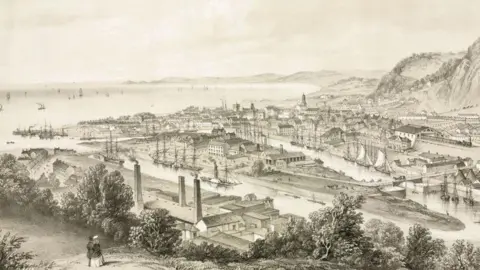
The Oystermouth Railway was initially built to carry Mumbles limestone and Clyne coal to Swansea docks, before investors worked out that they could cash in on the line’s stunning seafront location.
 Getty Images
Local entrepreneur Benjamin French, one of the line’s original proprietors, paid £20 a year to run passenger trains on the tramway from 25 March 1807, then the only link from Swansea to Oystermouth.
Wagons weaved through terraced streets of the old town before making its way along the seafront to the headland on the other side of Swansea Bay.
“A return ticket would cost a shilling, which in those days was a lot of money,” added local historian Phil Andrew, who gives talks to Swansea schoolchildren about the role their city played in the birth of the railways.
“There were arguments at the time in Swansea about industry or tourism.
“The population of Swansea in 1801 was about 6,000 people and the train started to take tourists to the seaside to enjoy the sea air, as much of south Wales was heavily industrialised at the time.”
 Swansea Museum | Swansea Council
After a successful start, the tramway shut in the 1820s after early interest waned and a road opened between Swansea and Oystermouth.
The line remained derelict until the 1850s when it was refurbished, re-laid and reopened as a standard gauge railway.
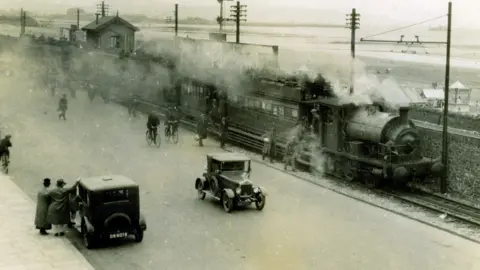
In 1877, steam trains were introduced – soon pulling 15 coaches and 1,300 people at a time.
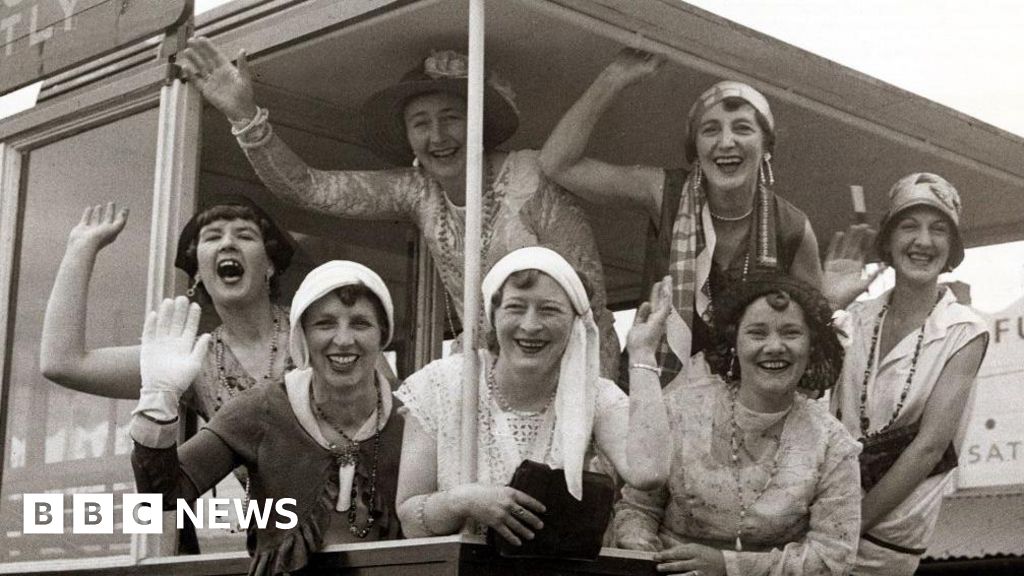
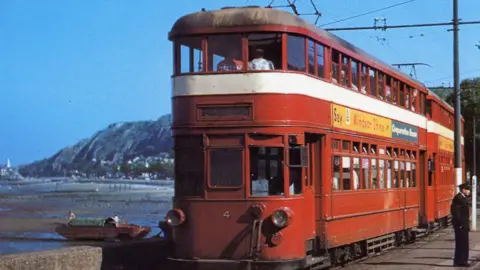
After the line was extended to the new Mumbles Pier in 1898, red electric tramcars were introduced in 1929 cutting the Swansea to Oystermouth journey time to 19 minutes.
“The seat backs were movable so you could either sit facing the direction of travel or you could go backwards,” recalled Nesta Wyn Rees, who lived in Uplands as a child and would catch the train to Oystermouth from Brynmill Station.
 Michael Eames
“The seats were a lovely leather, and we’d rattle around. We’d have an ice cream in Oystermouth. It was a wonderful day out. The location lent itself beautifully to a train ride,” added the 92-year-old.
At its height in the 1940s, nearly five million passengers a year rode the Swansea to Mumbles Railway – as it became officially known – as it helped to transform the Mumbles into a place for day trippers.
“Those trams make a huge noise, you’d hear the train before you saw it,” recalled Phil, a 76-year-old former primary school headteacher who rode the railway as a child.
“When it approached, the trams seemed to sway and slide along the track,” he added.
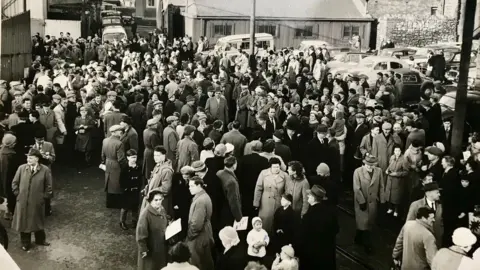
The beginning of the end came in 1958 when bus company South Wales Transport took it over and closed the line in January 1960 as they wanted to move people onto their buses.
“There was a great gathering of people there for the final day who all seemed in celebratory mood,” recalled Michael Eames, the current Swansea City football club kitman who was there as a six-year-old when the final Swansea to Mumbles Tram ran.
“But it was a very sad day. I don’t think people really realised how sad a day it was. Within days you could see them burning the trains and ripping up the track, I don’t think the city realised what we were losing.”
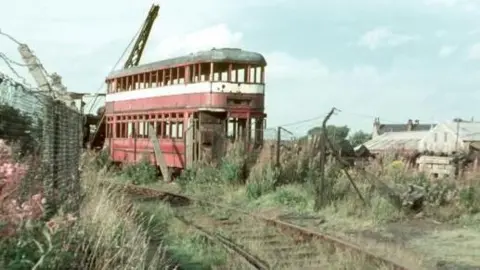 John Leeming | Geograph
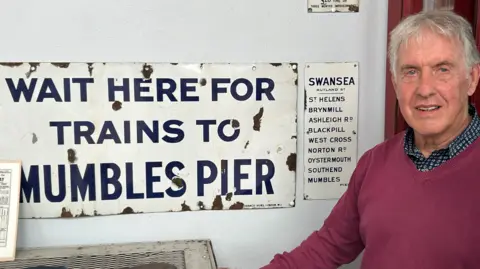
Many locals are now unaware of the area’s historical significance to transportation since only a few relics of the old Swansea to Mumbles line remain.
But those that have survived are partly thanks to former Swansea University history professor Prys Morgan.
One of the most prominent reminders is one of the line’s old stations at Blackpill, a building that also served as the tramway’s power station halfway around Swansea Bay.
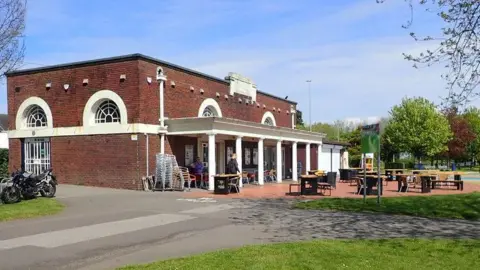 Eirian Evans | Geograph
“It was scheduled for demolition, so we fought to save it and it’s still here,” said Prof Morgan, the brother of Wales’ former First Minister Rhodri Morgan, as he sat in the cafe that now occupies the old station building.
“With its columns, it looked like a Roman temple. I love it so much and the magical red trams would glide silently into the platform.
“It’s a reminder of Swansea’s position in the early 19th Century as a world leader. We should have great pride in such a great moment of Welsh history, British history, industrial history and one of the greatest moments in Swansea’s history.”
#Swansea #railway #worlds #passenger #line